457 posters, 2 videos, 2 audios, 8 topics, 45 sessions, 401 authors, 265 institutions
ePostersLive by SciGen Technologies S.A. All rights reserved.
49th Annual Regional Anesthesiology and Acute Pain Medicine Meeting
March 21-23, 2024 | The Hilton Bayfront San Diego | San Diego, California

5168
MULTIMODAL PAIN MANAGEMENT APPROACH TO AVOID COMPLEX REGIONAL PAIN SYNDROME FLARE IN PATIENT UNDERGOING TOTAL KNEE ARTHROPLASTY
Poster Presenter
Authors
Affiliations
Part of Topic
Medically Challenging Cases
Case Report:
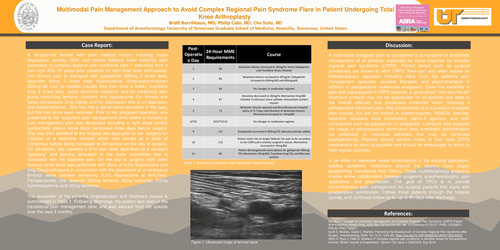
A 49-year-old female with past medical history including major depression, anxiety, OSA, and chronic bilateral lower extremity pain secondary to complex regional pain syndrome type 1 stemming from a torn right ACL 20 years prior presents for right total knee arthroplasty. Her chronic pain is managed with gabapentin 600mg 3 times daily, ibuprofen 60mg 3 times daily, Hydrocodone 10mg/acetaminophen 325mg q6 hour as needed (usually less than once a week), tizanidine 6mg 3 times daily, yearly ketamine infusions, and an intrathecal pain pump containing fentanyl, clonidine and bupivacaine. For anxiety she takes clonazepam 2mg nightly and for depression she is on bupropion and desvenlafaxine. She has had a spinal nerve stimulator in the past, but this has since been removed. Prior to her proposed operation, she presented to her outpatient pain management clinic where a transitional pain management plan was developed including a right sided lumbar sympathetic plexus nerve block performed three days before surgery. She was then admitted to the hospital two days prior to her surgery for initiation of a ketamine infusion which was started at a dose of 10mg/hour before being increased to 20mg/hour on the day of surgery. On admission, she reported a 6/10 pain level described as a constant “gnawing” and burning sensation in her lower extremities that is consistent with her baseline pain. On the day of surgery, right sided femoral nerve block was performed with 30mL of 0.5% Ropivacaine and 4mg Dexamethasone in conjunction with the placement of a continuous femoral nerve catheter containing 0.2% Ropivacaine at 8mL/hour. Perioperatively, she received 300mg fentanyl, 30mg ketorolac, 3.5mg hydromorphone, and 20mg ketamine.
The remainder of the patient’s hospitalization and treatment course is summarized in Table 1. Following discharge, the patient was seen in the transitional pain management clinic and was weaned from her opioids over the next 3 months.
Discussion:
A multimodal analgesic plan is considered a cornerstone of anesthetic management of all patients, especially for those impacted by complex regional pain syndrome (CRPS). Painful stimuli such as surgical procedures are known to elicit CRPS “flare-ups” and often require an interdisciplinary approach including input from the patient’s pain management specialist, physical therapist, and psychotherapist in addition to perioperative multimodal analgesics. Given the variability in pain and hyperalgesia in CRPS patients, a generalized “one-size-fits-all" treatment protocol may not be appropriate for all patients and adds to the overall difficulty that physicians encounter when choosing a perioperative treatment plan. Key components of a successful analgesic plan include, but are not limited to acetaminophen, NSAIDs, steroids, ketamine infusions, local anesthetics, alpha-2 agonists, and anti-convulsants such as gabapentin or pregabalin. Literature also supports the usage of pre-procedure continuous local anesthetic administration via peripheral or neuraxial catheters that may be continued postoperatively. Patients should resume intake of their daily CRPS medications as soon as possible and should be encouraged to return to their regular activities.
In an effort to decrease opioid consumption in the surgical population, leading academic institutions around the country have begun establishing Transitional Pain Clinics. These multidisciplinary programs involve active collaboration between surgeons, anesthesiologists, pain specialists, and pharmacists. The goal of TPCs is to provide comprehensive pain management for surgical patients that starts with preoperative optimization, follows these patients through the hospital course, and continues follow-up for up to 90 days after discharge.