457 posters, 2 videos, 2 audios, 8 topics, 45 sessions, 401 authors, 265 institutions
ePostersLive by SciGen Technologies S.A. All rights reserved.
49th Annual Regional Anesthesiology and Acute Pain Medicine Meeting
March 21-23, 2024 | The Hilton Bayfront San Diego | San Diego, California

5287
INTRAOPERATIVE THORACIC EPIDURAL MANAGEMENT: SURVEY OF FACULTY ANESTHESIOLOGISTS AT A LARGE ACADEMIC HOSPITAL
Poster Presenter
Part of Topic
Safety/QA/QI Projects
Intraoperative thoracic epidural management: A survey of faculty anesthesiologists at a large academic hospital
Joseph Hodapp MD, Milap Rakholia MD, Cynthia Khoo MD, PhD
Introduction
-
Expert consensus guidelines for intraoperative epidural management are lacking
-
UK society study: opioid-bupivacaine combination post-operatively, intraoperative not discussed1.
-
German regional anesthesiologist society: heterogeneity regarding intraoperative ropivacaine, opiate dosing, and rescue strategies2.
-
Some benefits of intraoperative use include reduction in postoperative morphine consumption and improvements in early pain experience3,4.
-
Our Aim: to define our institution’s current intraoperative epidural practices to help inform the development of future guidelines.
-
IRB approval obtained, protocol 72517
-
Single-center, quality improvement study including faculty in Stanford University Department of Anesthesiology, Perioperative and Pain Medicine
-
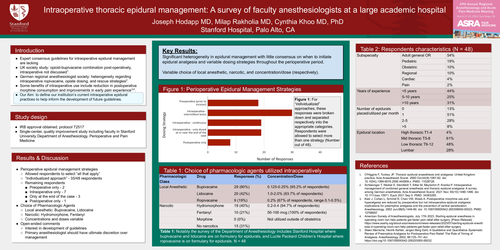
Perioperative epidural management strategies
-
Allowed respondents to select “all that apply”
-
“Individualized approach” - 35/48 respondents
-
Remaining respondents
-
Preoperative only - 2
-
Intraoperative only - 7
-
Only at the end of the case - 3
-
Postoperative only - 1
-
Choice of Pharmacologic Agents
-
Local anesthetic: Bupivacaine, Lidocaine
-
Narcotic: Hydromorphone, Fentanyl
-
Concentrations and doses variable
-
Open-ended comments
-
Interest in development of guidelines
-
Primary anesthesiologist should have ultimate discretion over management