457 posters, 2 videos, 2 audios, 8 topics, 45 sessions, 401 authors, 265 institutions
ePostersLive by SciGen Technologies S.A. All rights reserved.
49th Annual Regional Anesthesiology and Acute Pain Medicine Meeting
March 21-23, 2024 | The Hilton Bayfront San Diego | San Diego, California

5280
BILINGUAL TEXT MESSAGE FOLLOW UP SYSTEM FOR PEDIATRIC PATIENTS RECEIVING NERVE BLOCKS: AN IMPORTANT EFFORT TO ENHANCE INCLUSIVITY
Poster Presenter
Part of Topic
Safety/QA/QI Projects
Title: Bilingual Automated Text Messaging Follow-up System for Pediatric Patients Receiving Peripheral Nerve Blocks: An Important Effort To Enhance Inclusivity
Background:
- Effective communication with patients following regional anesthesia is crucial for assessing pain, patient satisfaction, and identifying potential complications related to nerve blocks.
- Traditionally, this involves a follow-up phone call the day after a procedure, which can be burdensome for patients and clinicians due to language differences and challenges in finding suitable times.
- In 2021, Gessner et al. introduced a low-cost text messaging system using REDCap-Twilio, achieving higher patient response rates by replacing daily calls with text surveys.
- This system was tailored to English-speaking adult patients only.
Aims
- Evaluate the effectiveness of the REDCap-Twilio automated text messaging system in pediatric patients who receive single-shot peripheral nerve blocks.
- Determine if this system improves response rates compared to our conventional follow-up via phone calls.
- Enhance the system by including bilingual capabilities to cater to the sizable Latinx community we care for at our institution.
Methods
- This project was determined by our IRB to be quality improvement.
- The system is built on REDCap, a secure and HIPAA-compliant online research data capture platform.
- The automated text messaging system queries patients who received various nerve block techniques, assesses patient-reported nerve block duration, and surveys patients for potential complications.
- The Spanish translation was developed by a native-speaking anesthesiologist and reviewed by a certified Spanish interpreter.
Results
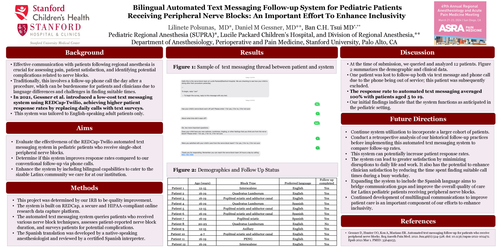
- At the time of submission, we queried and analyzed 12 patients. Figure 2 summarizes the demographic and clinical data.
- One patient was lost to follow-up both via text message and phone call due to the phone being out of service; this patient was subsequently excluded.
- The response rate to automated text messaging averaged 100% with patients aged 5 to 19.
- Our initial findings indicate that the system functions as anticipated in the pediatric setting.
Future Directions
- Continue system utilization to incorporate a larger cohort of patients.
- Conduct a retrospective analysis of our historical follow-up practices before implementing this automated text messaging system to compare follow-up rates.
- This system can potentially increase patient response rates.
- The system can lead to greater satisfaction by minimizing disruptions to daily life and work. It also has the potential to enhance clinician satisfaction by reducing the time spent finding suitable call times during a busy workday.
- Expanding the system to include the Spanish language aims to bridge communication gaps and improve the overall quality of care for Latinx pediatric patients receiving peripheral nerve blocks.
- Continued development of multilingual communications to improve patient care is an important component of our efforts to enhance inclusivity.