Loading...

457 posters, 2 videos, 2 audios, 8 topics, 45 sessions, 401 authors, 265 institutions

ePostersLive by SciGen Technologies S.A. All rights reserved.

49th Annual Regional Anesthesiology and Acute Pain Medicine Meeting

March 21-23, 2024 | The Hilton Bayfront San Diego | San Diego, California

49th Annual Regional Anesthesiology and Acute Pain Medicine Meeting banner

Part of Topic

Safety/QA/QI Projects

Environmental Impact of Medical Ultrasound Use

Connor Singrey, MD1, E.B. Fouts-Palmer, MD1, Vivian Ip, MBChB2, Deirdre C. Kelleher, MD1

1 Department of Anesthesiology, Weill Cornell Medicine, New York-Presbyterian Hospital, New York, NY

2 Department of Anesthesiology and Pain Medicine, Cumming School of Medicine, University of Calgary, Calgary, Canada


Introduction

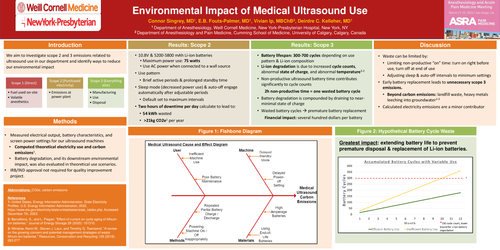
We aim to investigate scope 2 and 3 emissions related to ultrasound use in our department and identify ways to reduce our environmental impact

•Scope 1 (Direct)
•Fuel used on-site
•Volatile anesthetics
 
•Scope 2 (Purchased electricity)
•Emissions at power plant
 
•Scope 3 (Everything else)
•Manufacturing
•Use 
•Disposal 
 

Methods

•Measured electrical output, battery characteristics, and screen power settings for our ultrasound machines
•Computed theoretical electricity use and carbon emissions1.
•Battery degradation, and its downstream environmental impact, was also evaluated in theoretical use scenarios.
•IRB/IND approval not required for quality improvement project. 
 

 Results: Scope 2

•10.8V & 5200-5800 mAh Li-ion batteries
•Maximum power use: 75 watts
•Use AC power when connected to a wall source
•Use pattern
•Brief active periods & prolonged standby time
•Sleep mode (decreased power use) & auto-off engage automatically after adjustable periods
•Default set to maximum intervals
•Two hours of downtime per day calculate to lead to:
•54 kWh wasted
• >21kg CO2e1 per year
 

 Results: Scope 3

•Battery lifespan: 300-700 cycles depending on use pattern & Li-ion composition
•Li-ion degradation is due to increased cycle counts, abnormal state of charge, and abnormal temperature3-2
•Non-productive ultrasound battery time contributes significantly to cycle counts

  2h non-productive time = one wasted battery cycle

•Battery degradation is compounded by draining to near-minimal state of charge
•Wasted battery cycles à premature battery replacement

  Financial impact: several hundred dollars per battery


Discussion

•Waste can be limited by:
•Limiting non-productive “on” time: turn on right before use, turn off at end of use
•Adjusting sleep & auto-off intervals to minimum settings
•Early battery replacement leads to unnecessary scope 3 emissions.
•Beyond carbon emissions: landfill waste, heavy metals leeching into groundwater2-3
•Calculated electricity emissions are a minor contributor


Abbreviations: CO2e, carbon emissions


References

1: United States, Energy Information Administration. State Electricity Profiles. U.S. Energy Information Administration, 2022, https://www.eia.gov/electricity/state/unitedstates/state_tables.php. Accessed December 7th, 2023.

2: Barcellona, S., and L. Piegari. "Effect of current on cycle aging of lithium-ion batteries." Journal of Energy Storage 29 (2020): 101310.

3: Winslow, Kevin M., Steven J. Laux, and Timothy G. Townsend. "A review on the growing concern and potential management strategies of waste lithium-ion batteries." Resources, Conservation and Recycling.129 (2018): 263-277

49th Annual Regional Anesthesiology and Acute Pain Medicine Meeting » banner
Copyright © 2015-2026, ePostersLive® SciGen is a registered trademark of SciGen Technologies S.A. Patent pending.

This website and third-party tools we use rely on cookies for the best user experience. By selecting "I agree", you agree to cookie usage as described in our Privacy Policy.