457 posters, 2 videos, 2 audios, 8 topics, 45 sessions, 401 authors, 265 institutions
ePostersLive by SciGen Technologies S.A. All rights reserved.
49th Annual Regional Anesthesiology and Acute Pain Medicine Meeting
March 21-23, 2024 | The Hilton Bayfront San Diego | San Diego, California

5163
SUPERFICIAL CERVICAL BLOCKS AND LIDOCAINE INHALATION FOR AWAKE TRACHEOSTOMY
Poster Presenter
Authors
Affiliations
Part of Topic
Medically Challenging Cases
Superficial cervical blocks and lidocaine inhalation for awake tracheostomy
William Pintelon, Manuela Tejada, Gunar Subieta Benito Cook County Health
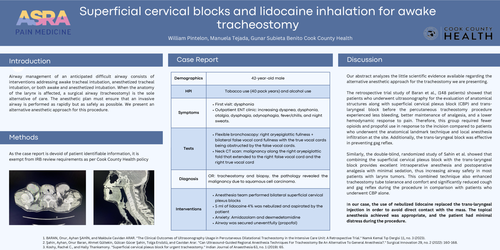
Introduction Airway management of an anticipated difficult airway consists of interventions addressing awake tracheal intubation, anesthetized tracheal intubation, or both awake and anesthetized intubation. When the anatomy of the larynx is affected, a surgical airway (tracheostomy) is the sole alternative of care. The anesthetic plan must ensure that an invasive airway is performed as rapidly but as safely as possible. We present an alternative anesthetic approach for this procedure.
Materials and Methods As the case report is devoid of patient identifiable information, it is exempt from IRB review requirements as per Cook County Health policy.
Case Report Patient is a 42-year-old male with a PMH of tobacco use (40 pack years) and daily alcohol use, who initially presented to the JHS emergency department for dysphonia. In the ED, an urgent ENT consult led to a flexible bronchoscopy demonstrating right aryepiglottic fullness plus bilateral false vocal cord fullness with the true vocal cords being obstructed by the false vocal cords. A neck CT scan showed malignancy along the right aryepiglottic fold that extended to the right false vocal cord and the right true vocal cord. A few days later, the patient presented to the outpatient ENT clinic with complaints of increasing dyspnea, dysphonia, otalgia, dysphagia, odynophagia, fever/chills and night sweats. He was taken to the OR for a tracheostomy and biopsy, the pathology revealed the malignancy due to squamous cell carcinoma. The anesthesia team performed bilateral superficial cervical plexus blocks. The block was evaluated by the surgeon, and surgical anesthesia was achieved. Due to the tumor burden, a transtracheal injection of local anesthetic was avoided and instead, 5 ml of lidocaine 4% was nebulized and aspirated by the patient. The patient was also given midazolam and dexmedetomidine to address his anxiety. The airway was secured uneventfully, and when the tracheal cannula was advanced, the patient was then sedated with propofol to complete the procedure.
Discussion According to the study of Baran et al.1, which was a retrospective trial with 148 patients enrolled, patients who underwent ultrasonography for the evaluation of anatomical structures along with superficial cervical plexus block (CBP) and trans-laryngeal block before the percutaneous tracheostomy procedure experienced less bleeding, better maintenance of analgesia, and a lower hemodynamic response to pain. Therefore, this group required fewer opioids and propofol use in response to the incision compared to patients who underwent the anatomical landmark technique and local anesthesia infiltration at the site. Additionally, the trans-laryngeal block was effective in preventing gag reflex. However, a disadvantage of using ultrasound-guided superficial cervical plexus block is that it is time consuming in urgent cases. For instance, a case report from India described the preference for the landmark technique when time was a critical factor.3 Similarly, the double-blind, randomized study of Sahin et al.2 showed that combining the superficial cervical plexus block with the trans-laryngeal block provides excellent intraoperative anesthesia and postoperative analgesia with minimal sedation, thus increasing airway safety in most patients with larynx tumors. This combined technique also enhanced tracheostomy tube tolerance and comfort and significantly reduced cough and gag reflex during the procedure in comparison with patients who underwent CBP alone. In our case, the use of nebulized lidocaine replaced the transtracheal injection in order to avoid direct contact with the mass. The topical anesthesia achieved was appropriate, and the patient had minimal distress during the procedure.
References 1. BARAN, Onur, Ayhan ŞAHİN, and Makbule Cavidan ARAR. "The Clinical Outcomes of Ultrasonography Usage in Percutaneous Dilatational Tracheostomy in the Intensive Care Unit: A Retrospective Trial." Namık Kemal Tıp Dergisi 11, no. 3 (2023). 2. Şahin, Ayhan, Onur Baran, Ahmet Gültekin, Gülcan Gücer Şahin, Tolga Ersözlü, and Cavidan Arar. "Can Ultrasound-Guided Regional Anesthesia Techniques For Tracheostomy Be An Alternative To General Anesthesia?." Surgical Innovation 29, no. 2 (2022): 160-168. 3. Koshy, Rachel C., and Hally Thankamony. "Superficial cervical plexus block for urgent tracheostomy." Indian Journal of Anaesthesia 63, no. 1 (2019): 65. Disclosures No