457 posters, 2 videos, 2 audios, 8 topics, 45 sessions, 401 authors, 265 institutions
ePostersLive by SciGen Technologies S.A. All rights reserved.
49th Annual Regional Anesthesiology and Acute Pain Medicine Meeting
March 21-23, 2024 | The Hilton Bayfront San Diego | San Diego, California

5225
IMPROVING PERIOPERATIVE NURSING KNOWLEDGE ON PERIPHERAL NERVE BLOCKS
Poster Presenter
Authors
Affiliations
Part of Topic
Safety/QA/QI Projects
Improving Perioperative Nursing Knowledge on Peripheral Nerve Blocks
Kelly Foster MD, Hannah Rasmussen MD, Mariam Sarwary MD, Ellile Sultan MD
Department of Anesthesiology, Perioperative and Pain Medicine. Stanford University School of Medicine.
Stanford, CA
Background
•The peri-anesthesia nursing team plays an important role in patient and family education of peripheral nerve blocks.
•The aim of this Quality Improvement project was to assess the confidence level of the nursing staff when caring for patients with peripheral nerve blocks in both the pre-operative and post anesthesia care unit at Stanford and identifying areas for improvement.
Methods
•An anonymous 7-question survey using a Likert scale was distributed to pre-operative and post anesthesia care unit nurses in four different hospital settings. The survey assessed their self reported confidence pertaining to assessing nerve blocks, knowledge of local anesthetics duration, sensory levels of different types of blocks, ability to assess for local anesthetic systemic toxicity (LAST), and location of intralipid.
•After a Zoom presentation, access to a new practical nerve block education guide was given. Then, an 8-question post-assessment survey was administered.
Results/Discussion
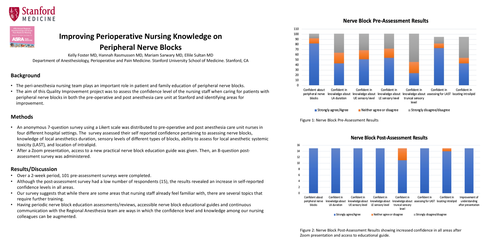
•Over a 2-week period, 101 pre-assessment surveys were completed.
•Although the post-assessment survey had a low number of respondents (15), the results revealed an increase in self-reported confidence levels in all areas.
•Our survey suggests that while there are some areas that nursing staff already feel familiar with, there are several topics that require further training.
•Having periodic nerve block education assessments/reviews, accessible nerve block educational guides and continuous communication with the Regional Anesthesia team are ways in which the confidence level and knowledge among our nursing colleagues can be augmented.