457 posters, 2 videos, 2 audios, 8 topics, 45 sessions, 401 authors, 265 institutions
ePostersLive by SciGen Technologies S.A. All rights reserved.
49th Annual Regional Anesthesiology and Acute Pain Medicine Meeting
March 21-23, 2024 | The Hilton Bayfront San Diego | San Diego, California

5286
ASSESSMENT OF PATIENT EXPERIENCE WITH VIRTUAL REALITY FOR ANXIOLYSIS DURING REGIONAL NERVE BLOCK AT AN AMBULATORY SURGERY CENTER
Poster Presenter
Part of Topic
Safety/QA/QI Projects
Assessment of patient experience with virtual reality during regional nerve block at an ambulatory surgery center
Joseph Hodapp M.D., Cora Steindl NP, Cynthia Khoo M.D., PhD
Introduction:
-
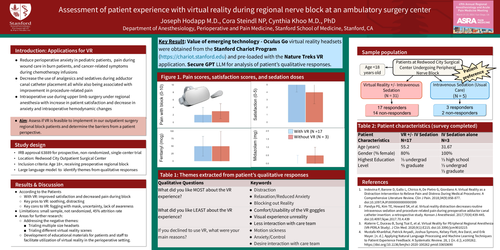
Reduce perioperative anxiety in pediatric patients, pain during wound care in burn patients, and cancer-related symptoms during chemotherapy infusions
-
Decrease the use of analgesics and sedatives during adductor canal catheter placement all while also being associated with improvement in procedure-related pain
-
Intraoperative use during upper limb surgery under regional anesthesia with increase in patient satisfaction and decrease in anxiety and intraoperative hemodynamic changes
-
Aim: Assess if VR is feasible to implement in our outpatient surgery regional block patients and determine the barriers from a patient perspective.
-
IRB approval 63889 for prospective, non-randomized, single-center trial
-
Location: Redwood City Outpatient Surgical Center
-
Inclusion criteria: Age 18+, receiving preoperative regional block
-
Large language model to identify themes from qualitative responses
-
According to the Patients
-
With VR: improved satisfaction and decreased pain during block
-
Key pros to VR: soothing, distracting
-
Key cons to VR: fogging with mask, uncertainty, lack of awareness
-
Limitations: small sample, not randomized, 45% attrition rate
-
Areas for further research:
-
Addressing the negative themes:
-
Trialing multiple size headsets
-
Trialing different virtual reality scenes
-
Development of educational materials for patients and staff to facilitate utilization of virtual reality in the perioperative setting.