457 posters, 2 videos, 2 audios, 8 topics, 45 sessions, 401 authors, 265 institutions
ePostersLive by SciGen Technologies S.A. All rights reserved.
49th Annual Regional Anesthesiology and Acute Pain Medicine Meeting
March 21-23, 2024 | The Hilton Bayfront San Diego | San Diego, California

5594
UNCOMMON SIDE-EFFECTS FROM THE SUPRAZYGOMATIC MAXILLAR NERVE BLOCK WITH OUT-OF-PLANE ULTRASOUND GUIDANCE TECHNIQUE
Poster Presenter
Authors
Affiliations
Part of Topic
Safety/QA/QI Projects
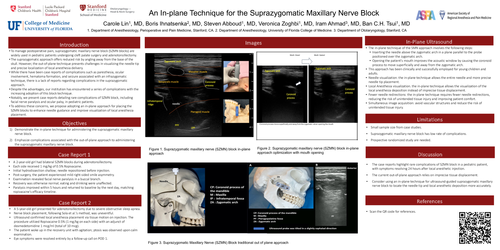
AN IN-PLANE TECHNIQUE FOR TEH SUPRAZYGOMATIC MAXILLARY NERVE BLOCK
INTRODUCTION
•To manage postoperative pain, suprazygomatic maxillary nerve block (SZMN blocks) are widely used in pediatric patients undergoing cleft palate surgery and adenotonsillectomy.
•The suprazygomatic approach offers reduced risk by angling away from the base of the skull. However, the out-of-plane technique presents challenges in visualizing the needle tip and precise localization of local anesthesia delivery.
•While there have been case reports of complications such as paresthesia, ocular involvement, hematoma formation, and seizure associated with an infrazygomatic technique, there is a lack of reports regarding complications in the suprazygomatic approach.
•Despite the advantages, our institution has encountered a series of complications with the increasing adoption of this block technique.
•Notably, we present case reports detailing rare complications of SZMN block, including facial nerve paralysis and ocular palsy, in pediatric patients.
•To address these concerns, we propose adopting an in-plane approach for placing the SZMN blocks to enhance needle guidance and improve visualization of local anesthesia placement.
OBJECTIVES
1)Demonstrate the in-plane technique for administering the suprazygomatic maxillary nerve block.
2)Emphasize complications associated with the out-of-plane approach to administering the suprazygomatic maxillary nerve block.
CASE REPORT 1
•A 2-year-old girl had bilateral SZMN blocks during adenotonsillectomy.
•Each side received 1 mg/kg of 0.5% Ropivacaine.
•Initial hydrodissection shallow; needle repositioned before injection.
•Post-surgery, the patient experienced mild right-sided smile asymmetry.
•Examination revealed facial nerve paralysis in a buccal branch.
•Recovery was otherwise normal; eating and drinking were unaffected.
•Paralysis improved within 5 hours and returned to baseline by the next day, matching ropivacaine's efficacy timeline.
CASE REPORT 2
•A 5-year-old girl presented for adenotonsillectomy due to severe obstructive sleep apnea.
•Nerve block placement, following Sola et al.'s method, was uneventful.
•Ultrasound confirmed local anesthesia placement via tissue motion on injection. The procedure utilized Ropivacaine 0.5% (1 mg/kg on each side) with an adjunct of dexmedetomidine 1 mcg/ml (total of 10 mcg).
•The patient woke up in the recovery unit with agitation; ptosis was observed upon calm examination.
•Eye symptoms were resolved entirely by a follow-up call on POD 1.
IN-PLANE ULTRASOUND
•The in-plane technique of the SMN approach involves the following steps:
•Inserting the needle above the zygomatic arch in a plane parallel to the probe positioned over the zygomatic arch.
•Opening the patient's mouth improves the acoustic window by causing the coronoid process to move superficially and away from the zygomatic arch.
•This approach has been clinically and successfully employed for young children and adults.
•Needle visualization: the in-plane technique allows the entire needle and more precise needle tip placement.
•Local Anesthesia visualization. the in-plane technique allows the visualization of the local anesthesia deposition instead of imprecise tissue displacement.
•Fewer needle redirections: the in-plane technique requires fewer needle redirections, reducing the risk of unintended tissue injury and improving patient comfort.
•Simultaneous image acquisition: avoid vascular structures and reduce the risk of unintended tissue injury.
LIMATIONS
•Small sample size from case studies.
•Suprazygomatic maxillary nerve block has low rate of complications
•Prospecitve randomized study needed
DISCUSSION
•The case reports highlight rare complications of SZMN block in a pediatric patient, with symptoms resolving 24 hours after local anesthetic injection.
•The current out-of-plane approach relies on imprecise tissue displacement.
•Consider using an in-plane technique for ultrasound-guided suprazygomatic maxillary nerve block to locate the needle tip and local anesthetic deposition more accurately.