457 posters, 2 videos, 2 audios, 8 topics, 45 sessions, 401 authors, 265 institutions
ePostersLive by SciGen Technologies S.A. All rights reserved.
49th Annual Regional Anesthesiology and Acute Pain Medicine Meeting
March 21-23, 2024 | The Hilton Bayfront San Diego | San Diego, California

5623
QUADRATUS LUMBORUM BLOCK CATHETERS FOR ABDOMINAL WALL ANALGESIA FOLLOWING DIEP FLAP RECONSTRUCTION
Poster Presenter
Part of Topic
Medically Challenging Cases
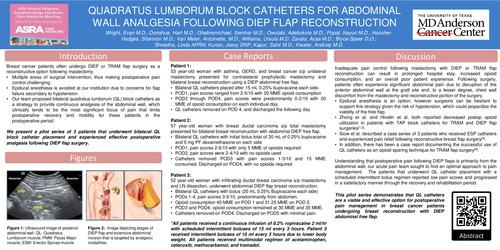
Wright, Evan M.D.; Donahue, Hart M.D.; Ghebremichael, Semhar M.D.; Owolabi, Adebukola M.D.; Popat, Keyuri M.D.; HancherHodges, Shannon M.D.; Van Meter, Antoinette, M.D.; Williams, Ursula M.D. Zavala, Acsa M.D.; Bryce Speer D.O.; Shrestha, Linda APRN; Kurian, Jessy DNP; Kapur, Sahil M.D.; Kwater, Andrzej M.D. Breast cancer patients often undergo DIEP or TRAM flap surgery as a reconstructive option following mastectomy. • Multiple areas of surgical intervention, thus making postoperative pain control challenging. • Epidural anesthesia is avoided at our institution due to concerns for flap failure secondary to hypotension. • Our team proposed bilateral quadratus lumborum (QL) block catheters as a strategy to provide continuous analgesia of the abdominal wall, which clinically tends to be the most significant focus of pain that limits postoperative recovery and mobility for these patients in the postoperative period. We present a pilot series of 3 patients that underwent bilateral QL block catheter placement and experienced effective postoperative analgesia following DIEP flap surgery. Patient 1: 53 year-old woman with asthma, GERD, and breast cancer s/p unilateral mastectomy presented for contralateral prophylactic mastectomy and bilateral breast reconstruction using a DIEP abdominal free flap. • Bilateral QL catheters placed after 15 mL 0.25% bupivacaine each side. • POD1, pain scores ranged from 2-5/10 with 20 MME opioid consumption • POD2 through POD4, pain scores were predominantly 0-2/10 with 20 MME of opioid consumption on each individual day. • QL catheters removed on POD 4, and discharged the following day Patient 2: 57 year-old woman with breast ductal carcinoma s/p total mastectomy presented for bilateral breast reconstruction with abdominal DIEP free flap. • Bilateral QL catheters with initial bolus total of 30 mL of 0.25% bupivacaine and 5 mg PF dexamethasone on each side • POD1, pain scores 2-6/10 with only 5 MME of opioids required • POD2, pain scores were 2-4/10 with no opioids used • Catheters removed POD3 with pain scores 1-3/10 and 15 MME consumed. Discharged on POD4, with no opioids required Patient 3: 52 year-old woman with infiltrating ductal breast carcinoma s/p mastectomy and LN dissection, underwent abdominal DIEP flap breast reconstruction. • Bilateral QL catheters with bolus (20 mL 0.25% Bupivacaine each side) • PODs 1-4, pain scores 3-5/10, predominantly from abdomen. • Opioid consumption 40 MME on POD 1 and 31.25 MME on POD 2. • POD3 and POD4, opioid consumption remained at 30 MME and 35 MME. • Catheters removed on POD4. Discharged on POD5 with minimal pain. QUADRATUS LUMBORUM BLOCK CATHETERS FOR ABDOMINAL WALL ANALGESIA FOLLOWING DIEP FLAP RECONSTRUCTION Figure 1: Ultrasound image of posterior abdominal wall. QL: Quadratus Lumborum muscle, PMM: Psoas Major muscle, ESM: Erector Spinae muscle Introduction Case Reports Discussion Inadequate pain control following mastectomy with DIEP or TRAM flap reconstruction can result in prolonged hospital stay, increased opioid consumption, and an overall poor patient experience. Following surgery, patients often experience significant abdominal pain due to disruption of the anterior abdominal wall at the graft site and, to a lesser degree, chest wall discomfort from the mastectomy and reconstructive portion of the surgery. • Epidural anesthesia is an option; however surgeons can be hesitant to support this strategy given the risk of hypotension, which could jeopardize the viability of the free flap. • Zhong et al. and Hivelin et al. both reported decreased postop opioid utilization in patients with TAP block catheters for TRAM and DIEP flap surgeries [1,2] . • Siow et al. described a case series of 3 patients who received ESP catheters and experienced pain relief following reconstructive breast flap surgery [3] . • In addition, there has been a case report documenting the successful use of QL catheters as an opioid-sparing technique for TRAM flap surgery [4] . Understanding that postoperative pain following DIEP flaps is primarily from the abdominal wall, our acute pain team sought to find an optimal approach to pain management. The patients that underwent QL catheter placement with a scheduled intermittent bolus regimen reported low pain scores and progressed in a satisfactory manner through the recovery and rehabilitation period. Figures Figure 2: Image depicting stages of DIEP flap and extensive abdominal incision that is targeted by analgesic modalities. This pilot series demonstrates that QL catheters are a viable and effective option for postoperative pain management in breast cancer patients undergoing breast reconstruction with DIEP abdominal free flap