457 posters, 2 videos, 2 audios, 8 topics, 45 sessions, 401 authors, 265 institutions
ePostersLive by SciGen Technologies S.A. All rights reserved.
49th Annual Regional Anesthesiology and Acute Pain Medicine Meeting
March 21-23, 2024 | The Hilton Bayfront San Diego | San Diego, California

5252
RETAINED EPIDURAL CATHETER AND MANEUVERS TO ASSIST IN REMOVAL
Poster Presenter
Authors
Affiliations
Part of Topic
Medically Challenging Cases
RETAINED EPIDURAL CATHETER AND MANEUVERS TO ASSIST IN REMOVAL
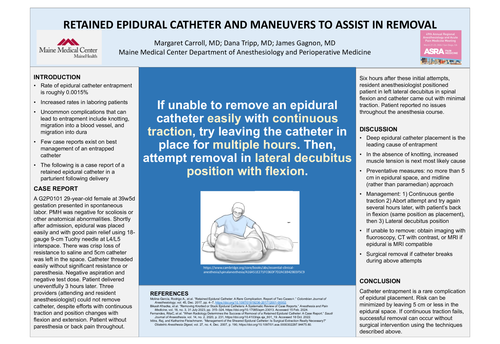
A G2P0101 29-year-old female at 39w5d gestation presented in spontaneous labor. PMH was negative for scoliosis or other anatomical abnormalities. Shortly after admission, epidural was placed easily and with good pain relief using 18-gauge 9-cm Tuohy needle at L4/L5 interspace. There was crisp loss of resistance to saline and 5cm catheter was left in the space. Catheter threaded easily without significant resistance or paresthesia. Negative aspiration and negative test dose. Patient delivered uneventfully 3 hours later. Three providers (attending and resident anesthesiologist) could not remove catheter, despite efforts with continuous traction and position changes with flexion and extension. Patient without paresthesia or back pain throughout. Six hours after these initial attempts, resident anesthesiologist positioned patient in left lateral decubitus in spinal flexion and catheter came out with minimal traction. Patient reported no issues throughout the anesthesia course.
DISCUSSION
CONCLUSION
Catheter entrapment is a rare complication of epidural placement. Risk can be minimized by leaving 5 cm or less in the epidural space. If continuous traction fails, successful removal can occur without surgical intervention using the techniques described above.