457 posters, 2 videos, 2 audios, 8 topics, 45 sessions, 401 authors, 265 institutions
ePostersLive by SciGen Technologies S.A. All rights reserved.
49th Annual Regional Anesthesiology and Acute Pain Medicine Meeting
March 21-23, 2024 | The Hilton Bayfront San Diego | San Diego, California

5410
BILATERAL LOWER EXTREMITY MOTOR BLOCKADE AFTER UNILATERAL LUMBAR PLEXUS NERVE CATHETER
Poster Presenter
Authors
Affiliations
Part of Topic
Medically Challenging Cases
Introduction
- Lumbar plexus nerve block is a regional technique typically used for intra/post operative pain management for procedures involving the femoral neck/shaft, the anterior, medial and lateral aspect of the thigh, the anterior aspect of the knee and the medial aspect of the leg.
- An unintended consequence this presentation reveals in potential epidural/ intrathecal spread from a unilateral lumbar plexus nerve block
Case Presentation
- 69-year-old male with a past medical history of heart failure (ejection fraction 39%), coronary artery disease, peripheral arterial disease and is status post a repair of a femoral artery pseudoaneurysm which subsequently resulted in above the knee amputation. On post-operative day 4 he required formalization of his amputation surgical site. On post-operative day 5 the patient was experiencing 10/10 pain at the surgical stump site.
- The acute pain service was consulted and right lumbar plexus nerve continuous catheter, given inability to perform a femoral nerve block as the post-surgical changes from the femoral artery pseudoaneurysm repair precluded this approach.
- A low frequency probe was used to identify lumbar plexus structures and an 18 gauge, insulated bevel tip needle was used. 20 ml of 0.5% bupivacaine was injected in increments of 5 mL, after negative aspiration prior to each injection. Spread was seen on ultrasound after confirming quadriceps contractions with a nerve stimulator at 1 mAmp and loss of contractions when decreasing it to 0.4 mAmp. A 21 gauge catheter was advanced to a skin depth of 7 cm and secured. The patient’s catheter was connected to an Ambit pump infusing ropivacaine 0.2% with an intermittent bolus setting at 15 ml every 3 hours.
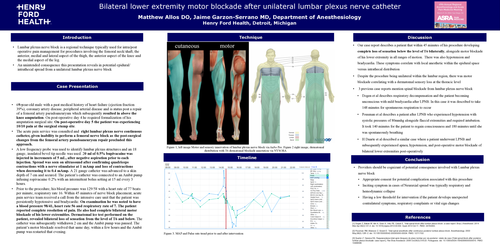
- Prior to the procedure, his blood pressure was 129/58 with a heart rate of 77 beats per minute, respiratory rate 16. Within 45 minutes of nerve block placement, acute pain service team received a call from the intensive care unit that the patient was persistently hypotensive and bradycardic. On examination he was noted to have a blood pressure 98/41, heart rate 56 and respiratory rate of 7. The patient reported complete resolution of pain. He also had complete bilateral motor blockade of his lower extremities. Dermatomal ice test performed on the patient, revealed bilateral loss of sensation from the level of T6 and below. The catheter was subsequently withdrawn 2 cm and the Ambit pump was paused. The patient’s motor blockade resolved that same day, within a few hours and the Ambit pump was restarted that evening.
Discussion
- Our case report describes a patient that within 45 minutes of his procedure developing complete loss of sensation below the level of T6 bilaterally, alongside motor blockade of his lower extremity in all ranges of motion. There was also hypotension and bradycardia. These symptoms correlate with local anesthetic within the epidural space versus intrathecal distribution
- Despite the procedure being unilateral within the lumbar region, there was motor blockade correlating with a dermatomal sensory loss at the thoracic level
- 3 previous case reports mention spinal blockade from lumbar plexus nerve block
- Dogen et al describes respiratory decompensation and the patient becoming unconscious with mild bradycardia after LPNB. In this case it was described to take 148 minutes for spontaneous respiration to occur
- Pousman et al describes a patient after LPNB who experienced hypotension with systolic pressures of 80mmhg alongside flaccid extremities and required intubation. It took 140 minutes for the patient to regain consciousness and 180 minutes until she was spontaneously breathing
- H Duarte et al described a similar case where a patient underwent LPNB and subsequently experienced apnea, hypotension, and post-operative motor blockade of bilateral lower extremities post-operatively
Conclusion
- Providers should be cognizant of potential consequence involved with Lumbar plexus nerve block
- Appropriate consent for potential complication associated with this procedure
- Inciting symptom in cases of Neuraxial spread was typically respiratory and hemodynamic collapse
- Having a low threshold for intervention if the patient develops unexpected contralateral symptoms, respiratory complaints or vital sign changes