457 posters, 2 videos, 2 audios, 8 topics, 45 sessions, 401 authors, 265 institutions
ePostersLive by SciGen Technologies S.A. All rights reserved.
49th Annual Regional Anesthesiology and Acute Pain Medicine Meeting
March 21-23, 2024 | The Hilton Bayfront San Diego | San Diego, California

5087
PROBABLE LOCAL ANESTHETIC SYSTEMIC TOXICITY IN AN ELDERLY PATIENT WITH SIGNIFICANT CARDIAC DISEASE
Poster Presenter
Authors
Affiliations
Part of Topic
Medically Challenging Cases
•Elderly patients with cardiac disease undergoing general anesthesia have elevated morbidity, mortality, and hospital readmission rates [1]
•Regional anesthesia mitigates anesthetic risk in this population through stress response attenuation, enhanced perioperative analgesia, and potential avoidance of general anesthesia entirely [2]
•Local anesthetic systemic toxicity (LAST) is one of the most feared risks of regional anesthesia.
•The incidence of LAST (0.18%) is decreasing given improvements in localization techniques and safety protocols [3,4]
•82F, 52kg presenting for left olecranon fracture ORIF
•PMH included CAD s/p PCI, ischemic and non-ischemic cardiomyopathy (NYHA class III symptoms), VT/Vfib arrest s/p ICD placement (2018), paroxysmal Afib (CHADS2VASc 6), hypothyroidism, and TIA
•Cardiac workup: EF of 55-60%, elevated PASP of 37, and mild to moderate aortic and mitral valve regurgitation; ICD evaluation showed no pacemaker dependence (DDD with 22% atrial pacing and 1% ventricular pacing)
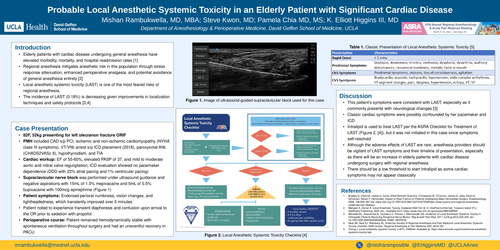
•Supraclavicular nerve block was performed under ultrasound guidance and negative aspirations with 15mL of 1.5% mepivacaine and 5mL of 0.5% bupivacaine with 100mcg epinephrine (Figure 1)
•Patient symptoms: Endorsed perioral numbness, vision changes, and lightheadedness, which transiently improved over 5 minutes
•Patient noted to experience transient diaphoresis and confusion upon arrival to the OR prior to sedation with propofol
•Perioperative course: Patient remained hemodynamically stable with spontaneous ventilation throughout surgery and had an uneventful recovery in PACU
•This patient’s symptoms were consistent with LAST, especially as it commonly presents with neurological changes [3]
•Classic cardiac symptoms were possibly confounded by her pacemaker and ICD
•Intralipid is used to treat LAST per the ASRA Checklist for Treatment of LAST (Figure 2, [4]), but it was not initiated in this case since symptoms self-resolved
•Although the adverse effects of LAST are rare, anesthesia providers should be vigilant of LAST symptoms and their timeline of presentation, especially as there will be an increase in elderly patients with cardiac disease undergoing surgery with regional anesthesia
•There should be a low threshold to start Intralipid as some cardiac symptoms may not appear classically