457 posters, 2 videos, 2 audios, 8 topics, 45 sessions, 401 authors, 265 institutions
ePostersLive by SciGen Technologies S.A. All rights reserved.
49th Annual Regional Anesthesiology and Acute Pain Medicine Meeting
March 21-23, 2024 | The Hilton Bayfront San Diego | San Diego, California

5552
COMBINING BLOCKS FOR HIP ARTHROPLASTY: PENG, FEMORAL NERVE, AND LATERAL FEMORAL CUTANEOUS NERVE BLOCKS FOR POSTOPERATIVE ANALGESIA
Poster Presenter
Authors
Affiliations
Part of Topic
Medically Challenging Cases
Combining Blocks for Hip Arthroplasty: PENG, Femoral Nerve, and Lateral Femoral Cutaneous Nerve Blocks for Postoperative Analgesia
Jacy Gressen, M.D., Keyuri Popat, M.D., Andrzej P. Kwater, M.D., Jodi Ann Oliver, M.D, Julie Mani, M.D., Adeel Faruki, M.D, Maria Ramirez Manotas, Adebukola Owolabi, M.D. Department of Anesthesiology and Perioperative Medicine, The University of Texas MD Anderson Cancer Center, Houston, TX
Introduction: Hip arthroscopies are associated with significant post-operative pain, complicating recovery, time to participation in physical therapy, and time to discharge. Given the age of the average hip arthroplasty patient, overuse of opioids or inadequate pain control can contribute to delirium, prolonged hospital stay, and worsening respiratory function. Regional nerve block techniques for hip arthroplasty most commonly include pericapsular nerve group (PENG) and fascia iliaca compartment block (FICB). However, limited guidance is offered in literature regarding which block(s) optimize pain control in the setting of various approaches to hip arthroscopic surgeries. We summarize our experience utilizing a combination of femoral, PENG, and lateral femoral cutaneous nerve (LFCN) blocks, which provided excellent pain control for two total hip arthroplasty oncologic patients.
Case Report: Patient 1: 67-year-old, 88 kg male with right hip pain due to osteolysis, pelvic fracture, and a failed right total hip replacement presented for revision of both components of prior right total hip. Due to the extent of this surgery, it was unlikely that any individual peripheral nerve block would provide satisfactory pain control. To increase analgesic coverage, a combination of femoral, PENG, and LFCN blocks were performed. His sensory block resolved at approximately 30 hours post-procedure. During recovery, he endorsed acceptable pain scores ranging from 2-4/10 and required no additional opioids during the hospitalization. Patient 2: 71-year-old female with history of thigh sarcoma s/p femur nail placement for radiation osteitis presented for proximal femur resection with hip hemiarthroplasty in the setting of left femoral neck fracture. She received 1 mg of IV hydromorphone intraoperatively but emerged with a severe pain. The regional team performed femoral, PENG, and LFCN blocks, which decreased her pain score to 0 for the next 15 hours. At 27 hours post-block, she started to report return of pain 5/10, for which she only required 0.25 mg hydromorphone for relief.
Technique
Local Anesthetic: 50 ml of 0.25% bupivacaine + 50 mcg of dexmedetomidine + 6 mg of preservative-free (PF) dexamethasone.
Femoral nerve block – 20mL
Pericapsular nerve group (PENG) block – 25mL
Lateral Femoral Cutaneous Nerve (LFCN) – 5mL
Both patients had multimodal pain regimens:
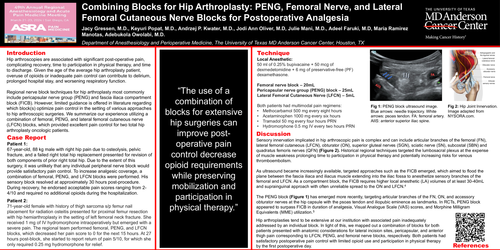
Discussion: Sensory innervation implicated in hip arthroscopic pain is complex and can include articular branches of the femoral (FN), lateral femoral cutaneous (LFCN), obturator (ON), superior gluteal nerves (SGN), sciatic nerve (SN), subcostal (SBN) and quadratus femoris nerves (QFN) (Figure 2). Historical regional techniques targeted the lumbosacral plexus at the expense of muscle weakness prolonging time to participation in physical therapy and potentially increasing risks for venous thromboembolism. As ultrasound became increasingly available, targeted approaches such as the FICB emerged, which aimed to flood the plane between the fascia iliaca and iliacus muscle extending into the iliac fossa to anesthetize sensory branches of the femoral and LFCN. As a compartment block, the FICB requires higher local anesthetic (LA) volumes of at least 30-40mL and suprainguinal approach with often unreliable spread to the ON and LFCN.4 The PENG block (Figure 1) has emerged more recently, targeting articular branches of the FN, ON, and accessory obturator nerves at the hip capsule with the psoas tendon and iliopubic eminence as landmarks. In RCTs, PENG block appeared to surpass FICB in duration of analgesia, Visual Analogue Scale (VAS) scores, and Morphine Milligram Equivalents (MME) utilization.5 Hip arthroplasties tend to be extensive at our institution with associated pain inadequately addressed by an individual block. In light of this, we mapped out a combination of blocks for both patients presented with anatomic considerations for lateral incision sites, pericapsular, and anterior thigh pain corresponding to LFCN, PENG, and femoral nerve blocks, respectively. Both patients had satisfactory postoperative pain control with limited opioid use and participation in physical therapy by the first postoperative day.
“The use of a combination of blocks for extensive hip surgeries can improve post-operative pain control decrease opioid requirements while preserving mobilization and participation in physical therapy.”