457 posters, 2 videos, 2 audios, 8 topics, 45 sessions, 401 authors, 265 institutions
ePostersLive by SciGen Technologies S.A. All rights reserved.
49th Annual Regional Anesthesiology and Acute Pain Medicine Meeting
March 21-23, 2024 | The Hilton Bayfront San Diego | San Diego, California

5549
NOVEL APPROACHES AND UTILIZATION OF CONTINUOUS PERIPHERAL NERVE BLOCKS TO MINIMIZE PAIN IN A PEDIATRIC PATIENT WITH 70% TBSA BURN
Poster Presenter
Authors
Affiliations
Part of Topic
Medically Challenging Cases
Novel Approaches & Utilization Continuous Peripheral Nerve Blocks to Minimize Pain in a Pediatric Patient with 70% TBSA Burn
Jessica Smitha, Abby Bennetta, and Jerry Jonesb MD
aCollege Of Medicine, The University of Tennessee Health Science Center, Memphis, TN, USA
bDepartment of Anesthesiology, The University of Tennessee Health Science Center, Memphis, TN, USA
Introduction
Childhood burns account for one-third of all burns in the U.S., but the associated pain, particularly from autograft harvesting, remains undertreated. Second- and third-degree burns in children create a unique scenario of acute on chronic pain during a prolonged course of treatment. There are numerous methods of pain management including opioids, non-opioid analgesics, and regional anesthesia. Regional anesthesia has been used to reduce the need for opioids following surgical procedures. However, opioid management remains more common than regional anesthetics for pain control in the pediatric population1. Decreasing opioid usage is vital as prolonged acute opioid use is a strong risk factor for chronic use and dependency in the burn patient population2.
Erector spinae plane blocks (ESPs) are a relatively new approach to pain management for a variety of different applications and can be used to provide thoracic, abdominal, and even some lower extremity analgesia. ESP blocks in children have mostly been used for perioperative pain control, but it has not been systematically studied for efficacy and standard procedure3. Cluneal nerve blocks are a relatively new procedure that have mainly been used for single injection pain relief for chronic back pain. There is little to no literature on the applications of continuous ESP or cluneal nerve blocks in burn or pediatric patients4. In this case study, a pediatric patient with >70% total body surface area (TBSA) burns received bilateral continuous ESP and cluneal nerve blocks, each requiring novel modifications to successfully minimize pain.
Case Report
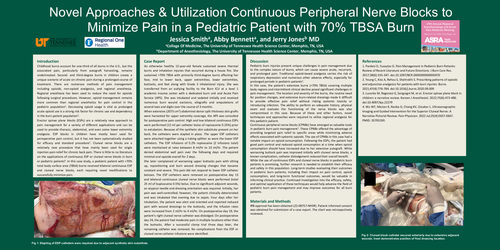
An otherwise healthy 12-year-old female sustained severe thermal burns and inhalation injuries that occurred during a house fire. She sustained >70% TBSA with primarily third-degree burns affecting her face, mid to lower back, upper extremities, lower extremities, buttocks, and feet along with Grade 3 inhalational injury. She was transferred from an outlying facility to the Burn ICU at a level 1 academic trauma center with a dedicated burn unit and Acute Pain Service (APS). She was intubated and sedated initially and received numerous burn wound excisions, allografts and amputations of several toes and digits over the course of 3 months.
When extensive (2073 cm2) abdominal donor split thickness skin grafts were harvested for upper extremity coverage, the APS was consulted for postoperative pain control. High and low bilateral continuous ESPs were performed (12 ml per catheter bolus of ropivacaine 0.25%) prior to extubation. Because of the synthetic skin substitute present on her back, the catheters were stapled in place. The upper ESP catheters were attached together using a tubing splitter as were the lower ESP catheters. The ESP infusions of 0.2% ropivacaine (2 infusions total) were maintained at rates between 8 ml/hr to 10 ml/hr. The patient denied abdominal wall pain over the following days and required minimal oral opioids overall for 2 days.
She later complained of worsening upper buttocks pain with sitting up, repositioning and burn wound dressing changes that became constant and severe. This pain did not respond to lower ESP catheter boluses. The ESP catheters were removed on postoperative day 13 and bilateral continuous clunealnerve blocks were performed (total 25 ml of bupivacaine 0.5%) bolus. Due to significant adjacent wounds, an atypical needle and dressing orientation was required. Initially, her pain was well-controlled; however, the patient clinically deteriorated and was intubated that evening due to sepsis. Four days after her intubation, the patient was alert and oriented and reported reduced pain with wound dressings to the buttocks, and the infusion rates were increased from 2 ml/hr to 4 ml/hr. On postoperative day 19, the patient’s right cluneal nerve catheter was dislodged. On postoperative day 24, the patient had moderate pain in multiple locations other than the buttocks. After a successful clamp trial three days later, the remaining catheter was removed. No complications from the ESP or cluneal nerve catheter infusions were identified.
Discussion
Pediatric burn injuries present unique challenges in pain management due to the complex nature of burns, which can cause severe acute, recurrent, and prolonged pain. Traditional opioid-based analgesia carries the risk of respiratory depression and numerous other adverse effects, especially for prolonged periods in pediatric patients1.
In this case, the patient's extensive burns (>70% TBSA) covering multiple body regions and intermittent clinical decline posed significant challenges in pain management. The location and severity of the burns, the routine need for position changes, and extensive burn-related dressings made it difficult to provide effective pain relief without risking systemic toxicity or introducing infection. The ability to perform an adequate history, physical exam and evaluate the functioning of the nerve blocks was also compromised in this case. Because of these and other factors, novel techniques and approaches were required to utilize regional analgesia for this pediatric patient.
Continuous peripheral nerve blocks (CPNBs) have emerged as valuable tools in pediatric burn pain management1. These CPNBs offered the advantage of providing targeted pain relief to specific areas while minimizing adverse effects associated with systemic opioids. The use of CPNBs in this case had a notable impact on opioid consumption. Following the ESPs, the patient had good pain control and reduced opioid consumption at a time when opioid consumption should have increased due to her extensive autograft. While worsening buttock pain was improved initially with cluneal nerve blocks, a known complication, catheter dislodgement reduced their overall benefit.
While the use of continuous ESPs and cluneal nerve blocks in pediatric burn patients is promising, further research is needed to establish their efficacy and safety in this population. Long-term studies evaluating their outcomes in pediatric burn patients, including their impact on pain control, opioid consumption, and long-term functional outcomes, would be valuable in informing clinical practice. Continued investigation into the efficacy, safety, and optimal application of these techniques would help advance the field of pediatric burn pain management and may improve outcomes for all burn patients.
Materials and Methods
IRB approval has been obtained (22-08757-NHSR). Patient informed consent was obtained for submission of a case report. The chart was retrospectively reviewed.
References
1. Pardesi O, Fuzaylov G. Pain Management in Pediatric Burn Patients: Review of Recent Literature and Future Directions. J Burn Care Res. 2017;38(6):335-347. doi:10.1097/BCR.0000000000000470
2. Yeung C, Kiss A, Rehou S, Shahrokhi S. Prescribing patterns of opioids and adjunctive analgesics for patients with burn injuries. Burns. 2021;47(4):776-784. doi:10.1016/j.burns.2020.09.009
3. Lucente M, Ragonesi G, Sanguigni M, et al. Erector spinae plane block in children: a narrative review. Korean J Anesthesiol. 2022;75(6):473-486. doi:10.4097/kja.22279
4. Wu WT, Mezian K, Nanka O, Chang KV, Ozcakar L. Ultrasonographic Imaging and Guided Intervention for the Superior Cluneal Nerve: A Narrative Pictorial Review. Pain Physician. 2022 Jul;25(4):E657-E667. PMID: 35793190.