457 posters, 2 videos, 2 audios, 8 topics, 45 sessions, 401 authors, 265 institutions
ePostersLive by SciGen Technologies S.A. All rights reserved.
49th Annual Regional Anesthesiology and Acute Pain Medicine Meeting
March 21-23, 2024 | The Hilton Bayfront San Diego | San Diego, California

5182
SUCCESSFUL DRAINAGE OF A THIGH ABSCESS UNDER FEMORAL BLOCK IN A PATIENT WITH SUBSTANCE USE AND HISTORY OF SEPTIC ENDOCARDITIS
Poster Presenter
Authors
Affiliations
Part of Topic
Medically Challenging Cases
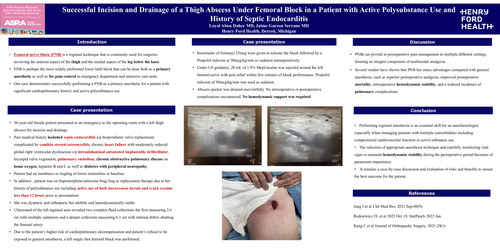
Successful Incision and Drainage of a Thigh Abscess Under Femoral Block in a Patient with Active Polysubstance Use and History of Septic Endocarditis
Femoral nerve block (FNB) is a regional technique that is commonly used for surgeries involving the anterior aspect of the thigh and the medial aspect of the leg below the knee. FNB was pioneered in 1952,and subsequent advancements, especially in ultrasound-guided techniques, have transformed the application of peripheral nerve blocks (PNBs) in upper limb procedures as well. FNB is perhaps the most widely performed lower limb block that can be done both as a primary anesthetic as well as for pain control in emergency department and critically ill patients. Our case demonstrates successfully performing a FNB as a primary anesthetic for a patient with significant cardiopulmonary history and active polysubstance use.
This is a case of a 56-year-old female patient (American Society of Anesthesiologists status IV) who presented as an emergency to the operating room with a left thigh abscess for incision and drainage. Patient reported pain and swelling around the left thigh at the site of previous femoral cutdown.
Past medical history included septic endocarditis s/p bioprosthetic valve replacement complicated by candida sternal osteomyelitis, intraabdominal automated implantable defibrillator, chronic heart failure with preserved ejection fraction and moderately reduced global right ventricular dysfunction, tricuspid valve vegetation, pulmonary embolism, chronic obstructive pulmonary disease on home oxygen, hepatitis B, hepatitis C as well as diabetes with peripheral neuropathy. Moreover, patient was on buprenorphine/naloxone 8mg/2mg as replacement therapy due to her history of polysubstance use including active use of both intravenous heroin and crack cocaine less than 12 hours prior to presentation. She was dyspneic on exertion, orthopneic but afebrile and hemodynamically stable at the time of assessment. Ultrasound of the left inguinal area revealed two complex fluid collections the first measuring 2.6 cm with multiple septations and a deeper collection measuring 6.1 cm with internal debris abutting the femoral artery. Patient had no numbness or tingling of left lower extremity at the time of evaluation.
Due to the patient’s higher risk of cardiopulmonary decompensation and patient’s refusal to be exposed to general anesthesia, a left single shot femoral block was performed under US guidance. Patient was premedicated with 1mg increments of Midazolam and 25mcg of Fentanyl to a total of 2mg and 100mcg respectively. Twenty mL of 1.5% Mepivacaine was injected around the left femoral nerve. Patient started to report relief from pain within few minutes of block performance. A propofol infusion of 50mcg/kg/min was used as sedation. Subsequently, incision and drainage of the left thigh collection was successfully done revealing a 12 cm x 8 cm 5 cm abscess pocket extending to the muscle fascia with purulent drainage. This procedure was uneventful during the intraoperative period and there were no complications postoperatively. The patient did not complain of any pain or discomfort, and the hemodynamic parameters were stable.
PNBs are pivotal in postoperative pain management in multiple different settings, forming an integral component of multimodal analgesia. Several studies have shown that PNB has many advantages compared with general anesthesia, such as superior postoperative analgesia, improved postoperative mortality, intraoperative hemodynamic stability, and a reduced incidence of pulmonary complications. It is an essential skill for an anesthesiologist especially when managing patients with multiple comorbidities including compromised cardiovascular function or active substance use. The selection of appropriate anesthesia technique and carefully monitoring vital signs to maintain hemodynamic stability during the perioperative period becomes of paramount importance. It remains a case-by-case discussion and evaluation of risks and benefits to ensure the best outcome for the patient.