457 posters, 2 videos, 2 audios, 8 topics, 45 sessions, 401 authors, 265 institutions
ePostersLive by SciGen Technologies S.A. All rights reserved.
49th Annual Regional Anesthesiology and Acute Pain Medicine Meeting
March 21-23, 2024 | The Hilton Bayfront San Diego | San Diego, California

5305
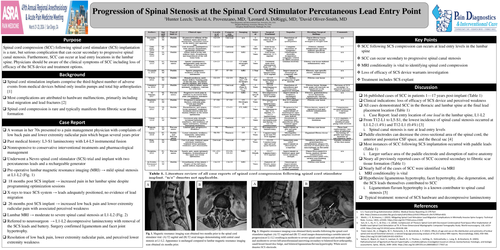
PROGRESSION OF SPINAL STENOSIS AT THE SPINAL CORD STIMULATOR PERCUTANEOUS LEAD ENTRY POINT
Poster Presenter
Authors
Affiliations
Part of Topic
Medically Challenging Cases
Title: Progression of Spinal Stenosis at the Spinal Cord Stimulator Percutaneous Lead Entry Point
Purpose: Spinal cord compression (SCC) following spinal cord stimulator (SCS) implantation is a rare, but serious complication that can occur secondary to progressive spinal canal stenosis. Furthermore, SCC can occur at lead entry locations in the lumbar spine. Physicians should be aware of the clinical symptoms of SCC including loss of efficacy of the SCS device and treatment options.
Background:
- Spinal cord stimulation implants comprise the third-highest number of adverse events from medical devices behind only insulin pumps and total hip arthroplasties [1]
- Most complications are attributed to hardware malfunctions, primarily including lead migration and lead fractures [2]
- Spinal cord compression is rare and typically manifests from fibrotic scar tissue formation
Case Report:
- A woman in her 70s presented to a pain management physician with complaints of low back pain and lower extremity radicular pain which began several years prior
- Past medical history: L3-S1 laminectomy with L4-L5 instrumental fusion
- Nonresponsive to conservative interventional treatments and pharmacological management
- Underwent a Nevro spinal cord stimulator (SCS) trial and implant with two percutaneous leads and a rechargeable generator
- Pre-operative lumbar magnetic resonance imaging (MRI) → mild spinal stenosis at L1-L2 (Fig. 1)
- 18 months post SCS implant → increased pain in her lumbar spine despite programming optimization sessions
- X-rays to trace SCS system → leads adequately positioned, no evidence of lead migration
- 26 months post SCS implant → increased low back pain and lower extremity radicular pain with associated perceived weakness
- Lumbar MRI → moderate to severe spinal canal stenosis at L1-L2 (Fig. 2)
- Referred to neurosurgeon → L1-L2 decompressive laminectomy with removal of the SCS leads and battery. Surgery confirmed ligamentum and facet joint hypertrophy.
- Resolution of low back pain, lower extremity radicular pain, and perceived lower extremity weakness
Key Points:
- SCC following SCS compression can occurs at lead entry levels in the lumbar spine
- SCC can occur secondary to progressive spinal canal stenosis
- MRI conditionality is vital to identifying spinal cord compression
- Loss of efficacy of SCS device warrants investigation
- Treatment includes SCS explant
Discussion:
- 16 published cases of SCC in patients 1—17 years post-implant (Table 1)
- Clinical indications: loss of efficacy of SCS device and perceived weakness
- All cases demonstrated SCC in the thoracic and lumbar spine at the final lead placement location (Table 1)
- Case Report: lead entry location of one lead in the lumbar spine, L1-L2
- From T12-L1 to L5-S1, the lowest incidence of spinal canal stenosis occurred at L1-L2 (1.4%) and T12-L1 (0.4%) [3]
- Spinal canal stenosis is rare at lead entry levels
- Paddle electrodes can decrease the cross-sectional area of the spinal cord, the anterior and posterior CSF space, and the thecal sac [4]
- Most instances of SCC following SCS implantation occurred with paddle leads (Table 1)
- Larger surface area of the paddle electrode and disruption of native anatomy
- Neary all previously reported cases of SCC occurred secondary to fibrotic scar tissue formation (Table 1)
- Nearly half of the cases of SCC were identified via MRI
- MRI conditionality is vital
- Hypothesize ligamentous hypertrophy, facet hypertrophy, disc degeneration, and the SCS leads themselves contributed to SCC
- Ligamentum flavum hypertrophy is a known contributor to spinal canal stenosis [5]
- Typical treatment: removal of SCS hardware and decompressive laminectomy
References:
- U.S. Food and Drug Administration (2020c). Medical Device Reporting 21 CFR Part 803. https://www.accessdata.fda.gov/scripts/cdrh/cfdocs/cfcfr/CFRSearch.cfm?CFRPart=803.
- Walsh, J. P., & Jimenez, J. (2022). Mitigating Spinal Cord Stimulator Lead Migration Complications in Minimally Invasive Spine Surgery: Technical Note. Cureus, 14(3), e23343. https://doi.org/10.7759/cureus.23343
- Son, B. C., Ko, H. C., & Choi, J. G. (2018). Compression of Thoracic Spinal Cord with Decreased Cerebrospinal Fluid Space After Implantation of Paddle Lead Spinal Cord Stimulation at T9: A Three-Dimensional Myelographic Computed Tomography Study. World neurosurgery, 118, e323–e334. https://doi.org/10.1016/j.wneu.2018.06.186
- Travis Caton, M., Jr, Wiggins, W. F., Pomerantz, S. R., & Andriole, K. P. (2021). Effects of age and sex on the distribution and symmetry of lumbar spinal and neural foraminal stenosis: a natural language processing analysis of 43,255 lumbar MRI reports. Neuroradiology, 63(6), 959–966. https://doi.org/10.1007/s00234-021-02670-6
- Sairyo, K., Biyani, A., Goel, V., Leaman, D., Booth, R., Jr, Thomas, J., Gehling, D., Vishnubhotla, L., Long, R., & Ebraheim, N. (2005). Pathomechanism of ligamentum flavum hypertrophy: a multidisciplinary investigation based on clinical, biomechanical, histologic, and biologic assessments. Spine, 30(23), 2649–2656. https://doi.org/10.1097/01.brs.0000188117.77657.ee