457 posters, 2 videos, 2 audios, 8 topics, 45 sessions, 401 authors, 265 institutions
ePostersLive by SciGen Technologies S.A. All rights reserved.
49th Annual Regional Anesthesiology and Acute Pain Medicine Meeting
March 21-23, 2024 | The Hilton Bayfront San Diego | San Diego, California

5567
TRIGGER POINT INJECTION COMPLICATED BY RETAINED FOREIGN BODY: A CASE REPORT
Poster Presenter
Authors
Part of Topic
Medically Challenging Cases
Myofascial trigger points, defined as “hyperirritable points located in
taut bands of skeletal muscle, which when compressed, produce a
referred pain characteristic of that muscle and a pain that the subject
recognizes,” [1] are common components of chronic multifactorial pain.
Several common treatments for myofascial trigger points exist including
vapocoolant spray, dry-needling, ischemic compression, deep-stroking
massage, and injection. [2]
Currently, there are no studies or guidelines on the most appropriate
bevel type, needle length and needle gauge for trigger point injection.
This case demonstrates a rare complication of trigger point injections.
A 51-year-old male with a history of hypertension, hyperlipidemia, recent
non-ST-elevated myocardial infarction (NSTEMI) on dual antiplatelet
therapy presented for evaluation of chronic neck and low back pain.
Physical exam was significant for lumbar paraspinal trigger points.
Epidural steroid injection was deferred due to the blood thinners the
patient had recently started following NSTEMI, and the patient elected for
trigger point injection (TPI).
A 30 gauge, 0.5 inch hypodermic needle was utilized for the paraspinal
TPI with 10 mL total 1% lidocaine injectate. As the needle was withdrawn
from the right lower lumbar paraspinal musculature, the entire metal
portion of the needle was noted to be missing. There was no fragment of
the needle retained in the hub. An ultrasound was obtained which
revealed the needle retained in the tissue. Fluoroscopy visualized the
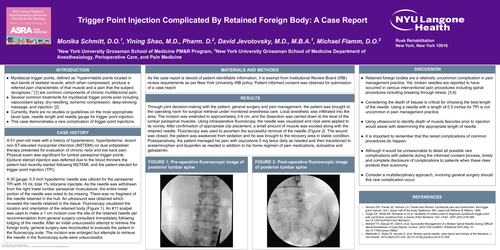
location and orientation of the retained body (Figure 1). An #11 scalpel
was used to make a 1 cm incision over the site of the retained needle per
recommendation from general surgery consultant immediately following
lodging of the needle. After an initial unsuccessful attempt to retrieve the
foreign body, general surgery was reconsulted to evaluate the patient in
the fluoroscopy suite. The incision was enlarged but attempts to retrieve
the needle in the fluoroscopy suite were unsuccessful.