457 posters, 2 videos, 2 audios, 8 topics, 45 sessions, 401 authors, 265 institutions
ePostersLive by SciGen Technologies S.A. All rights reserved.
49th Annual Regional Anesthesiology and Acute Pain Medicine Meeting
March 21-23, 2024 | The Hilton Bayfront San Diego | San Diego, California

5519
QUADRATUS LUMBORUM CATHETERS TO THE RESCUE: OPEN RPLND FOR TESTICULAR CANCER
Poster Presenter
Part of Topic
Medically Challenging Cases
Introduction
Testicular neoplasms, one of the most common malignancies in younger male patients, is amongst the most curable malignancies due to modern advancements. Treatment often involves chemotherapy as well as surgical interventions, with both modalities being utilized in more disseminated disease.1 Retroperitoneal lymph node dissection (RPLND) is a common surgery performed for patients diagnosed with testicular cancer and serves as a staging, diagnostic, and potentially therapeutic intervention. The incision for these open procedures extends from the xiphoid process to below the umbilicus along the midline abdomen. Postoperative pain control and progression through recovery can be challenging given the extensive incisional and visceral pain. In this case report, we present a scenario in which quadratus lumborum (QL) block catheters served as an effective alternative (and rescue) to epidural anesthesia for abdominal wall analgesia following RPLND surgery.
Materials and Methods
Informed consent for regional anesthesia and inclusion in this case report was obtained. As this case report is devoid of any patient identifiable information, it is exempt from IRB review requirements per our institutional policy.
Results/Case Report
A 28 year-old man with stage IIIB intermediate-risk testicular non-seminomatous germ cell tumor (NSGCT) presented for RPLND in the setting of retroperitoneal, supraclavicular, and mediastinal adenopathy following initial chemotherapy treatment. Initial discussion for postoperative analgesia included placement of a thoracic epidural. However, this was not attainable in the preoperative period due to a variety of constraints and obstacles. Therefore, the decision was made to reserve any neuraxial or regional anesthetic techniques for the postoperative period.
Intraoperatively, the patient received intravenous fentanyl and hydromorphone in addition to ketamine and dexmedetomidine infusions for multimodal analgesia. On arrival to recovery, the initial plan involved placement of a thoracic epidural in lateral decubitus position. However, after several attempts and utilization of ultrasound guidance for better identification of landmarks, the decision was made to abort epidural placement in favor of QL block catheters as an alternative.
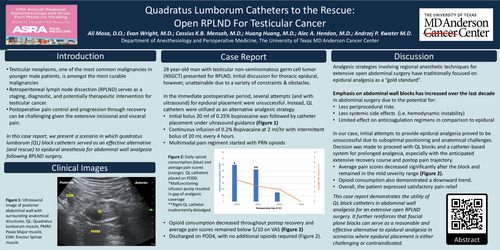
With the patient in lateral decubitus position and using a curvilinear probe, the posterior abdominal wall was scanned to identify the QL muscle and surrounding anatomy. A 20 gauge echogenic needle was inserted in-plane and advanced to the posterior aspect of the QL muscle. Following an initial bolus injection of 20 ml of 0.25% Bupivacaine, a catheter was advanced to the posterior aspect of the QL muscle and confirmed with ultrasound visualization (Figure 1). The same procedure was repeated on the contralateral side. A continuous infusion of 0.2% ropivacaine was started at 2 ml/hour with an intermittent bolus schedule of 20 ml every 4 hours. The patient was also placed on a multimodal pain regimen which included acetaminophen, methocarbamol, celecoxib, and hydrocodone/acetaminophen.
During the subsequent postoperative days (POD), the patient experienced satisfactory pain control with the QL catheters in place and progressed expeditiously to full recovery. Opioid consumption was 60 Morphine Milligram Equivalents (MME) on POD1 and 52.5 MME on POD2. The initial peaks in opioid use on POD1 was due to a malfunctioning infusion pump that created a gap in analgesic coverage and on POD2, the right-sided catheter was inadvertently removed with positioning changes. Average pain scores on POD1 and POD2 were 4.4/10 and 3.1/10 respectively on the visual analog scale (VAS). On POD3, the left-sided catheter was removed in anticipation of discharge, and opioid consumption was minimal at 15 MME with an average pain score of 2.5/10. The patient was subsequently discharged on POD4, with no additional opioids required (Figure 2).
Discussion
Analgesic strategies involving regional anesthetic techniques for extensive open abdominal surgery have traditionally focused on epidural analgesia. In more recent years, there has been a trend towards the use of fascial plane blocks as an alternative in the setting of enhanced recovery protocols emphasizing early mobilization and time-efficient progression through recovery goals. These abdominal wall blocks initially focused on transversus abdominis plane (TAP) and rectus sheath blocks, but more recently have evolved to quadratus lumborum (QL) blocks and erector spinae plane (ESP) blocks for more reliable somatic and visceral analgesic coverage.
Regional anesthetic blocks or epidural analgesia have proven to be beneficial for surgical patients in reducing opioid consumption, opioid-related side effects, and optimizing recovery. As it relates to oncologic care, there is even some evidence to suggest that incorporation of regional anesthetic techniques could make a favorable impact on cancer recurrence.2 Emphasis on abdominal wall blocks has increased over the last decade in abdominal surgery due to the potential for less periprocedural risks, less systemic side effects (i.e. hemodynamic instability), and limited effect on anticoagulation regimens in comparison to epidural analgesia. Additionally, ESP and QL blocks have demonstrated significant benefit as analgesic modalities for patients undergoing open urologic surgery.3,4 However, in the setting of extensive open abdominal procedures with an expected prolonged recovery period, many would argue in favor of using epidural analgesia as a “gold standard”, with evidence supporting its superiority in analgesic effectiveness.5 Therefore, epidural analgesia is often considered as a primary strategy with abdominal wall fascial plane blocks (TAP, QL, ESP) as a secondary alternative.
In our case, initial attempts to provide epidural analgesia proved to be unsuccessful due to suboptimal positioning and anatomical challenges. The decision was made to proceed with QL blocks and a catheter- based system for prolonged analgesia, especially with the anticipated extensive recovery course. Average pain scores decreased significantly after the block and remained in the mild severity range (Figure 2). Opioid consumption also demonstrated a downward trend postoperatively. This progression of pain was also affected by a malfunctioning infusion pump and inadvertent dislodgement of one of the catheters. Overall, the patient expressed satisfactory pain relief throughout the postoperative period.
This case report demonstrates the utility of QL block catheters in providing abdominal wall analgesia for an extensive open RPLND surgery. It further reinforces that fascial plane blocks as a regional technique can serve as a reasonable and effective alternative to epidural analgesia in scenarios where epidural placement is either challenging or contraindicated.