457 posters, 2 videos, 2 audios, 8 topics, 45 sessions, 401 authors, 265 institutions
ePostersLive by SciGen Technologies S.A. All rights reserved.
49th Annual Regional Anesthesiology and Acute Pain Medicine Meeting
March 21-23, 2024 | The Hilton Bayfront San Diego | San Diego, California

5300
SYMPTOMS OF LOCAL ANESTHETIC SYSTEMIC TOXICITY (LAST) AFTER SUPRASCAPULAR NERVE BLOCK
Poster Presenter
Authors
Affiliations
Part of Topic
Medically Challenging Cases
Symptoms of LAST after Suprascapular Nerve Block
Peripheral nerve blocks using local anesthetics are a common and effective means of improving pain control and minimizing opioid use in the perioperative period. While advances in these techniques, such as ultrasound guidance, have made their performance significantly safer, complications are still possible, some of which may be devastating. One such complication is local anesthetic systemic toxicity (LAST), a rare and potentially life-threatening adverse event characterized by central nervous system (CNS) disturbance and cardiovascular toxicity. In the following case, we describe a suspected case of LAST following suprascapular nerve block in a patient undergoing reverse total shoulder arthroplasty.
The patient provided written informed consent for the utilization of his medical condition and management. As the case report is devoid of patient identifiable information, it is exempt from IRB review requirements as per Walter Reed National Military Medical Center policy.
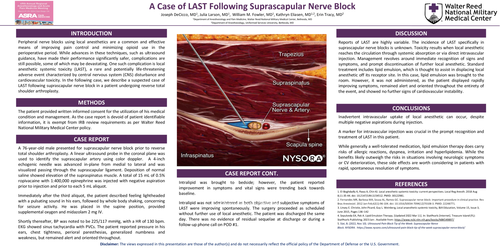
A 76-year-old male presented for suprascapular nerve block prior to reverse total shoulder arthroplasty. A linear ultrasound probe in the coronal plane was used to identify the suprascapular artery using color doppler. A 4-inch echogenic needle was advanced in-plane from medial to lateral and was visualized passing through the suprascapular ligament. Deposition of normal saline showed elevation of the supraspinatus muscle. A total of 15 mL of 0.5% ropivacaine with 1:400,000 epinephrine was injected with negative aspiration prior to injection and prior to each 5 mL aliquot.
Immediately after the third aliquot, the patient described feeling lightheaded with a pulsating sound in his ears, followed by whole body shaking, concerning for seizure activity. He was placed in the supine position, provided supplemental oxygen and midazolam 2 mg IV.
Shortly thereafter, BP was noted to be 225/117 mmHg, with a HR of 130 bpm. EKG showed sinus tachycardia with PVCs. The patient reported pressure in his ears, chest tightness, perioral paresthesias, generalized numbness and weakness, but remained alert and oriented throughout.
Intralipid was brought to bedside; however, the patient reported improvement in symptoms and vital signs were trending back towards baseline.
Intralipid was not administered as both objective and subjective symptoms of LAST were improving spontaneously. The surgery proceeded as scheduled without further use of local anesthetic. The patient was discharged the same day. There was no evidence of residual sequelae at discharge or during a follow-up phone call on POD #1.
Reports of LAST are highly variable. The incidence of LAST specifically in suprascapular nerve blocks is unknown. Toxicity results when local anesthetic reaches the circulation through systemic absorption or via direct intravascular injection. Management revolves around immediate recognition of signs and symptoms, and prompt discontinuation of further local anesthetic. Standard treatment includes lipid emulsion, which is thought to assist in displacing local anesthetic off its receptor site. In this case, lipid emulsion was brought to the room. However, it was not administered, as the patient displayed rapidly improving symptoms, remained alert and oriented throughout the entirety of the event, and showed no further signs of cardiovascular instability.
Inadvertent intravascular uptake of local anesthetic can occur, despite multiple negative aspirations during injection.
A marker for intravascular injection was crucial in the prompt recognition and treatment of LAST in this patient.
While generally a well-tolerated medication, lipid emulsion therapy does carry risks of allergic reactions, dyspnea, irritation and hyperlipidemia. While the benefits likely outweigh the risks in situations involving neurologic symptoms or CV deterioration, these side effects are worth considering in patients with rapid, spontaneous resolution of symptoms.
1. El-Boghdadly K, Pawa A, Chin KJ. Local anesthetic systemic toxicity: current perspectives. Local Reg Anesth. 2018 Aug 8;11:35-44. doi: 10.2147/LRA.S154512. PMID: 30122981.
2. Fernandes MR, Barbosa MA, Sousa AL, Ramos GC. Suprascapular nerve block: important procedure in clinical practice. Rev Bras Anestesiol. 2012 Jan-Feb;62(1):96-104. doi: 10.1016/S0034-7094(12)70108-3. PMID: 22248771.
3. Linsey E. Christie, John Picard, Guy L. Weinberg, Local anaesthetic systemic toxicity, BJA Education, Volume 15, Issue 3, June 2015, Pages 136–142
4. Sepulveda EA, Pak A. Lipid Emulsion Therapy. [Updated 2022 Mar 11]. In: StatPearls [Internet]. Treasure Island (FL): StatPearls Publishing; 2023 Jan-. Available from: https://www.ncbi.nlm.nih.gov/books/NBK549897/
5. Slat, B. (2022, Nov 10). Ultrasound Pain Block Tip of the Week: Suprascapular Nerve Block. NYSORA. https://www.nysora.com/ultrasound-pain-block-tip-of-the-week-suprascapular-nerve-block/