457 posters, 2 videos, 2 audios, 8 topics, 45 sessions, 401 authors, 265 institutions
ePostersLive by SciGen Technologies S.A. All rights reserved.
49th Annual Regional Anesthesiology and Acute Pain Medicine Meeting
March 21-23, 2024 | The Hilton Bayfront San Diego | San Diego, California

5184
MULTIPLE SINGLE - INJECTION SPINALS FOR BROMELAIN ‐ BASED ENZYMATIC BURN DEBRIDEMENT
Poster Presenter
Authors
Affiliations
Part of Topic
Medically Challenging Cases
Multiple Single-Injection Spinals for Bromelain Based Enzymatic Burn Debridement
Christina Zecca, M.D., Nicolas Salvatierra, M.D., Meaghan Kenfield, M.D., Justin Chung, M.D., Tiffany Tedore, M.D
Department of Anesthesiology, NewYork-Presbyterian/Weill Cornell Medicine, New York, NY
Introduction:
-
Bromelain-based enzymatic debridement is a novel method for debridement of deep dermal / full thickness burns derived from pineapple plant stem extract 1
-
Pain management during treatment can be a challenge secondary to the severity of pain and length of the procedures 2,3
-
A consideration for regional anesthesia is the percentage of total body surface area (TBSA) burned and location of the burn 2,3
-
Catheters should not be placed through burned skin or eschar, but single-injection spinal anesthesia and nerve blocks can safely be performed through burned skin 2,3
-
In cases where neuraxial is utilized and a catheter is contraindicated, the duration of sensory blockade may not be sufficient for the entirety of the procedure 2,3
-
Repeated spinal anesthesia, which has been performed safely in other patient populations, can be considered 4
Case Description
-
A 24-year-old male with no significant past medical history presented with 21.5% TBSA scald burn to the back and bilateral lower extremities, scheduled for bromelain-based debridement of his lower extremities in the ICU
-
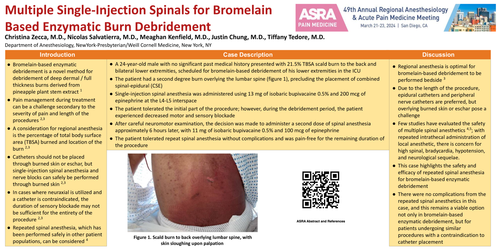
The patient had a second degree burn overlying the lumbar spine (figure 1), precluding the placement of combined spinal-epidural (CSE)
-
Single-injection spinal anesthesia was administered using 13 mg of isobaric bupivacaine 0.5% and 200 mcg of epinephrine at the L4-L5 interspace
-
The patient tolerated the initial part of the procedure; however, during the debridement period, the patient experienced decreased motor and sensory blockade
-
After careful neuromotor examination, the decision was made to administer a second dose of spinal anesthesia approximately 6 hours later, with 11 mg of isobaric bupivacaine 0.5% and 100 mcg of epinephrine
-
The patient tolerated repeat spinal anesthesia without complications and was pain-free for the remaining duration of the procedure
Discussion
-
Regional anesthesia is optimal for bromelain-based debridement to be performed bedside 3
-
Due to the length of the procedure, epidural catheters and peripheral nerve catheters are preferred, but overlying burned skin or eschar pose a challenge
-
Few studies have evaluated the safety of multiple spinal anesthetics 4,5; with repeated intrathecal administration of local anesthetic, there is concern for high spinal, bradycardia, hypotension, and neurological sequelae.
-
This case highlights the safety and efficacy of repeated spinal anesthesia for bromelain-based enzymatic debridement
-
There were no complications from the repeated spinal anesthetics in this case, and this remains a viable option not only in bromelain-based enzymatic debridement, but for patients undergoing similar procedures with a contraindication to catheter placement