457 posters, 2 videos, 2 audios, 8 topics, 45 sessions, 401 authors, 265 institutions
ePostersLive by SciGen Technologies S.A. All rights reserved.
49th Annual Regional Anesthesiology and Acute Pain Medicine Meeting
March 21-23, 2024 | The Hilton Bayfront San Diego | San Diego, California

5288
FASCIA ILIACA COMPARTMENT BLOCK FOR WASHOUT OF SEPTIC HIP JOINT IN A PATIENT WITH CONGESTIVE HEART FAILURE IN SEPTIC SHOCK
Poster Presenter
Authors
Affiliations
Part of Topic
Medically Challenging Cases
Fascia iliaca compartment block for incision and drainage of septic hip joint in a patient with congestive heart failure in septic shock
Abstract
The use of regional anesthesia in critically ill patients can reduce anesthetic requirements and negate the need for general anesthesia.6 The facia iliaca compartment block (FICB) is a plane block that has the potential to anesthetize the femoral, obturator, genitofemoral, and lateral femoral cutaneous nerves.5 Preoperative FICB has been shown to significantly reduce hip fracture pain in patients waiting for arthroplasty surgery.1 Although it is well established that FICB significantly reduces acute pain, few cases exist that have used FICB as regional anesthesia. Our case report demonstrates the successful use of FICB for regional anesthesia in a cardiac patient in septic shock requiring incision and drainage of the right hip.
Case Description
A 73 year-old man with PMH of diabetes, myocardial infarction 2 months prior requiring home milrinone drip via PICC line, knee and hip arthroplasty in China was admitted to Maimonides Medical Center for management of septic shock likely secondary to septic arthritis of the right hip. Patient was managed in the cardiac ICU where they placed a right internal jugular central line and pulmonary artery (PA) catheter to monitor for cardiogenic shock. In the ICU, the patient was on vasopressin and milrinone drips. Other medications include: Amiodarone, Apixaban (stopped the day prior to surgery), Clopidogrel (stopped the day prior to surgery), insulin, and Cefepime.
Echocardiogram showed reduced ejection fraction (EF) 21-25% and LV thrombus. Blood cultures significant for serratia species. CT scan of lower extremity showed air pockets surrounding right hip joint, suspicious for infection. Patient was booked for incision and drainage of the right hip for source control of septic arthritis. Cardiac anesthesiologist and regional anesthesiologist planned for FICB and sedation, as he was a poor candidate for general or spinal anesthesia.
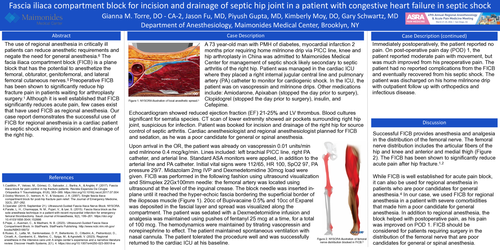
Upon arrival in the OR, the patient was already on vasopressin 0.01 units/min and milrinone 0.4 mcg/kg/min. Lines included: left brachial PICC line, right PA catheter, and arterial line. Standard ASA monitors were applied, in addition to the arterial line and PA catheter. Initial vital signs were 112/65, HR 100, SpO2 97, PA pressure 29/7. Midazolam 2mg IVP and Dexmedetomidine 30mcg load were given. FICB was performed in the following fashion using ultrasound visualization and Stimuplex 22Gx100mm needle: the femoral artery was located using ultrasound at the level of the inguinal crease. The block needle was inserted in-plane until it reached the hyper-echoic fascia bordering the superficial border of the iliopsoas muscle (Figure 1). 20cc of Bupivacaine 0.5% and 10cc of Exparel was deposited in the fascial layer and spread was visualized along the compartment. The patient was sedated with a Dexmedetomidine infusion and analgesia was maintained using pushes of fentanyl 25 mcg at a time, for a total of 100 mcg. The hemodynamics were maintained by titrating vasopressin and norepinephrine to effect. The patient maintained spontaneous ventilation with nasal cannula. The patient tolerated the procedure well and was successfully returned to the cardiac ICU at his baseline.
Immediately postoperatively, the patient reported no pain. On post-operative pain day (POD) 1, the patient reported moderate pain with movement, but was much improved from his preoperative pain. The patient had no reported complications from the FICB and eventually recovered from his septic shock. The patient was discharged on his home milrinone drip with outpatient follow up with orthopedics and infectious disease.
Discussion
Successful FICB provides anesthesia and analgesia in the distribution of the femoral nerve. The femoral nerve distribution includes the articular fibers of the hip and knee and anterior and medial thigh (Figure 2). The FICB has been shown to significantly reduce acute pain after hip fracture.1,2
While FICB is well established for acute pain block, it can also be used for regional anesthesia in patients who are poor candidates for general anesthesia.4 In our case, we used FICB for regional anesthesia in a patient with severe comorbidities that made him a poor candidate for general anesthesia. In addition to regional anesthesia, the block helped with postoperative pain, as his pain was improved on POD 1. FICB should be considered for patients requiring surgery in the distribution of the femoral nerve that are poor candidates for general or spinal anesthesia.