457 posters, 2 videos, 2 audios, 8 topics, 45 sessions, 401 authors, 265 institutions
ePostersLive by SciGen Technologies S.A. All rights reserved.
49th Annual Regional Anesthesiology and Acute Pain Medicine Meeting
March 21-23, 2024 | The Hilton Bayfront San Diego | San Diego, California

5227
MULTIPLE FALSE-NEGATIVE TEST DOSES OF UNREALIZED INTRAVASCULAR THORACIC EPIDURAL CATHETER: A CASE REPORT
Poster Presenter
Authors
Affiliations
Part of Topic
Medically Challenging Cases
Multiple False-Negative Test Doses of Unrealized Intravascular Thoracic Epidural Catheter: A Case Report
Rory Loo, MD; Alexander Linse, MD; Aidan Hoie, MD; Shea Stoops, DO; Kyle Marshall, MD
University of Colorado Anschutz Medical Campus
INTRO
Following thoracic epidural catheter placement, it is standard practice to test the location of the catheter as unrealized misplacement can have severe consequences.
Testing is performed via aspiration of the catheter and administering a test dose of lidocaine with epinephrine.
While the response to this injection may vary, the expected change in an intravascular catheter is an increase in heart rate and blood pressure.
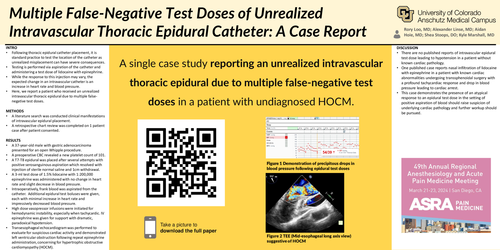
Here, we report a patient who received an unrealized intravascular thoracic epidural due to multiple false- negative test doses.
A literature search was conducted clinical manifestations of intravascular epidural placement.
A retrospective chart review was completed on 1 patient case after patient consented.
RESULTS
37-year-old male with gastric adenocarcinoma presented for an open Whipple procedure.
A preoperative CBC revealed a new platelet count of 101.
A T7-T8 epidural was placed after several attempts with positive serosanguinous aspiration which resolved with injection of sterile normal saline and 1cm withdrawal.
A 3-ml test dose of 1.5% lidocaine with 1:200,000 epinephrine was administered with no change in heart rate and slight decrease in blood pressure. Intraoperatively, frank blood was aspirated from the catheter. Additionalepiduraltestbolusesweregiven, each with minimal increase in heart rate and impressively decreased blood pressure.
High dose vasopressor infusions were initiated for hemodynamic instability, especially when tachycardic. IV epinephrine was given for support with dramatic, paradoxical hypotension.
Transesophageal echocardiogram was performed to evaluate for suspicious cardiac activity and demonstrated left ventricular obstruction following repeat epinephrine administration, concerning for hypertrophic obstructive cardiomyopathy (HOCM).
DISCUSSION
There are no published reports of intravascular epidural test dose leading to hypotension in a patient without known cardiac pathology.
One published case reports nasal infiltration of lidocaine with epinephrine in a patient with known cardiac abnormalities undergoing transsphenoidal surgery with a profound tachycardiac response and drop in blood pressure leading to cardiac arrest.
This case demonstrates the presence of an atypical response to an epidural test dose in the setting of positive aspiration of blood should raise suspicion of underlying cardiac pathology and further workup should be pursued.