457 posters, 2 videos, 2 audios, 8 topics, 45 sessions, 401 authors, 265 institutions
ePostersLive by SciGen Technologies S.A. All rights reserved.
49th Annual Regional Anesthesiology and Acute Pain Medicine Meeting
March 21-23, 2024 | The Hilton Bayfront San Diego | San Diego, California

5203
EPIDURAL ASSESSMENT IN THE SETTING OF PRE-EXISTING NEUROPATHY
Poster Presenter
Authors
Affiliations
Part of Topic
Medically Challenging Cases
Title: Epidural Assessment in the Setting of Pre-existing Neuropathy
Background:
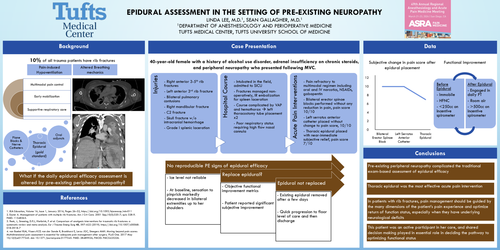
Rib fractures are found in at least 10% of all trauma patients and have significant morbidity and mortality secondary to pain-induced hypoventilation and altered breathing mechanics.1 Optimal management of rib fractures includes multimodal pain control, early mobilization, and supportive respiratory care to reduce pulmonary complications.2 Options for analgesia in this setting are vast, but mainly consist of oral narcotics, plane blocks, nerve catheters, thoracic epidurals, with the addition of other pharmacological adjuncts (ie NSAIDs, gabapentin, lidocaine patches). Thoracic epidurals are often cited as the gold standard for analgesia in the setting of multiple rib fractures, however, the literature on the comparative effectiveness of pain control in this setting is lacking.3
Epidural efficacy is assessed with day-to-day neurological exams, however there is no existing literature regarding assessment in patients whose baseline neurological exam is altered by pre-existing neuropathy.
This case presents a unique patient with multiple rib fractures experiencing severe pain in whom the efficacy of pain interventions was difficult to assess because of her pre-existing peripheral neuropathy. This case discusses using her functional improvement as the pain intervention end point rather than objective unilateral pain scores or physical exam data.
Materials and Methods:
As the case report is devoid of patient identifiable information, it is exempt from IRB review requirements as per Tufts Medical Center policy.
Case Report:
40-year-old female with a past medical history of alcohol use disorder, adrenal insufficiency on chronic steroids, and peripheral neuropathy who presented following motor vehicle collision. She was unresponsive at the scene and intubated for airway protection. On arrival, she was found to have bilateral rib fractures (right 3-5th, left 3rd), bilateral pulmonary contusions, right mandibular fracture, C2 fracture, skull fracture without intracranial hemorrhage, and grade I splenic laceration.
She was admitted to the surgical ICU. All fractures were managed non-operatively and she was extubated on hospital day 5. Her course was complicated by ventilator associated pneumonia, poor respiratory status requiring high flow nasal cannula, and hemothorax requiring left thoracostomy tube placement. Her pain was difficult to control following extubation despite a multimodal regimen including oral and intravenous narcotics, NSAIDs, and gabapentin. Bilateral erector spinal blocks were performed without any reduction in pain. A left serratus anterior catheter was placed but pain scores remained consistently 10/10. She was hesitant to make any movements due to her pain, could only speak in a few words at a time because of her shallow breathing, and was pulling less than 250cc on her incentive spirometer. Given ongoing poor pain control, a thoracic epidural was placed, which resulted in near-immediate subjective in near-immediate subjective improvement in pain score to 7/10.
Despite immediate subjective improvement in pain, physical exam never revealed any objective signs of epidural efficacy. Ice level was not reliable and her sensation to pinprick was markedly decreased in bilateral extremities up to her shoulders which was consistent with her existing neuropathy prior to thoracic epidural placement.
Despite the lack of data to support the thoracic epidural was working, the patient had significant clinical improvement over the next several days. She was weaned of high flow nasal cannula to room air, her incentive spirometer volumes doubled, and she participated in physical therapy for the first time since admission. Therefore, although replacement of epidural was considered, this was not done due to the holistic observation of and patient reported functional improvement. The epidural was removed after a few days and the patient had quick progression to floor level of care and then discharge.
Discussion:
The presence of pre-existing peripheral neuropathy complicated the traditional exam-based assessment of epidural efficacy in this patient. Objectively the thoracic epidural was not working, but subjectively the patient’s pain improved as evidenced by functional improvement, which what ultimately led to her recovery and ability to leave the hospital. The reason behind functional improvement despite lack of data to support appropriate epidural efficacy could be due to her underlying peripheral neuropathy, though a placebo effect must be considered as well. This is an important example of using functional improvement as the pain intervention endpoint when typical objective data and subjective pain scores are difficult to assess.
Additionally, she required multiple regional pain interventions before her pain was controlled. Less invasive plane blocks were attempted, but in this patient it was the thoracic epidural that worked, which supports the thoracic epidural as the gold standard for rib fractures. However, this could be in part due to lead time bias.
Ultimately this case points out the importance of holistically assessing patients’ pain experience in the treatment of acute pain. If the team had relied only on physical exam, which was clouded by her pre-existing peripheral neuropathy, the patient likely would have undergone another invasive replacement of the thoracic epidural potentially without improvement in that pain score, which could have led to frustration and decreased motivation to actively participate in care.
Therefore, this case shows that in patients with rib fractures pain management should be guided by the many dimensions of the patient’s pain experience and optimize return of functional status, especially when they have underlying neurological deficits. Patient-centered pain management where patients are active participants leads to the best outcomes.