457 posters, 2 videos, 2 audios, 8 topics, 45 sessions, 401 authors, 265 institutions
ePostersLive by SciGen Technologies S.A. All rights reserved.
49th Annual Regional Anesthesiology and Acute Pain Medicine Meeting
March 21-23, 2024 | The Hilton Bayfront San Diego | San Diego, California

5109
PUDENDAL NERVE BLOCKADE FOR PERSISTENT GENITAL AROUSAL DISORDER (PGAD): A CLINICAL REVIEW AND CASE REPORT
Poster Presenter
Authors
Affiliations
Part of Topic
Medically Challenging Cases
Pudendal Nerve Blockade for Persistent Genital Arousal Disorder (PGAD): A Clinical Review and Case Report
Authors: Michael J. Gyorfi, MD1; Alaa Abd-Elsayed, MD, MBA, MPH, CPE, FASA1
1. Anesthesiology and pain management, University of Wisconsin School of Medicine and Public Health, Madison, WI, USA
Persistent Genital Arousal Disorder (PGAD) is characterized by unwanted and potentially painful genital sensations or spontaneous orgasms without stimulation. The prevalence of PGAD in two large non-clinical samples ranged from 0.6 to 4.3%. Factors that may contribute to the development of PGAD: nerve damage, spinal cord lesions, pelvic congestion, hormonal dysregulation, psychiatric disorders, pelvic floor disorders, trauma, and sexual abuse.
Conservative treatment for PGAD includes physical therapy, pelvic floor exercises, and medications such as SSRIs, anticonvulsants, and hormonal therapies. Refractory cases of PGAD may undergo pudendal nerve decompressive surgery or clitoral artery embolization.
RW is a 55-year-old female with chronic pelvic pain, pudendal neuralgia, major depressive disorder, suicidal ideation, general anxiety disorder, complex regional pain syndrome of the right leg, and persistent genital arousal disorder for 11 years. She rated her pain a 7/10 with frequent flares of 10/10 pain. RW believes that her chronic pelvic discomfort and pain directly correlates with her psychiatric mood disorders and actively causes suicidal ideation. Her PGAD was refractory to conservative management, physical therapy, and bilateral clitoral artery embolization. RW trialed numerous medications. We performed serial pudendal nerve blocks with 2-3 months of 90% pain reduction.
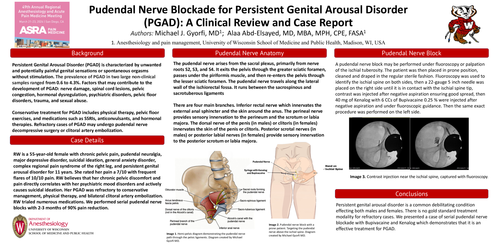
The pudendal nerve arises from the sacral plexus, primarily from nerve roots S2, S3, and S4. It exits the pelvis through the greater sciatic foramen, passes under the piriformis muscle, and then re-enters the pelvis through the lesser sciatic foramen. The pudendal nerve travels along the lateral wall of the ischiorectal fossa. It runs between the sacrospinous and sacrotuberous ligaments
There are four main branches. Inferior rectal nerve which innervates the external anal sphincter and the skin around the anus. The perineal nerve provides sensory innervation to the perineum and the scrotum or labia majora. The dorsal nerve of the penis (in males) or clitoris (in females) innervates the skin of the penis or clitoris. Posterior scrotal nerves (in males) or posterior labial nerves (in females) provide sensory innervation to the posterior scrotum or labia majora.
A pudendal nerve block may be performed under fluoroscopy or palpation of the ischial tuberosity. The patient was then placed in prone position, cleaned and draped in the regular sterile fashion. Fluoroscopy was used to identify the ischial spine on both sides, then a 22-gauge 5 inch needle was placed on the right side until it is in contact with the ischial spine tip, contrast was injected after negative aspiration ensuring good spread, then 40 mg of Kenalog with 6 CCs of Bupivacaine 0.25 % were injected after negative aspiration and under fluoroscopic guidance. Then the same exact procedure was performed on the left side.
Persistent genital arousal disorder is a common debilitating condition effecting both males and females. There is no gold standard treatment modality for refractory cases. We presented a case of serial pudendal nerve blockade with Bupivacaine and Kenalog which demonstrates that it is an effective treatment for PGAD.