457 posters, 2 videos, 2 audios, 8 topics, 45 sessions, 401 authors, 265 institutions
ePostersLive by SciGen Technologies S.A. All rights reserved.
49th Annual Regional Anesthesiology and Acute Pain Medicine Meeting
March 21-23, 2024 | The Hilton Bayfront San Diego | San Diego, California

5086
IPSILATERAL ARM PARESTHESIA AND WEAKNESS AFTER SINGLE SHOT PARAVERTEBRAL BLOCK
Poster Presenter
Authors
Affiliations
Part of Topic
Medically Challenging Cases
Title: IPSILATERAL UPPER EXTREMITY PARESTHESIA AND WEAKNESS AFTER SINGLE SHOT PARAVERTEBRAL BLOCK
Thoracic paravertebral block (TPVB) is the technique of injecting local anesthetic adjacent to the thoracic vertebra close to where the spinal nerves emerge from the intervertebral foramina. This results in ipsilateral somatic and sympathetic nerve blockade in multiple contiguous thoracic dermatomes above and below the site of injection. It is effective in treating acute and chronic pain in the chest and abdomen. The factors responsible for the spreading pattern of a single paravertebral injection are still uncertain.
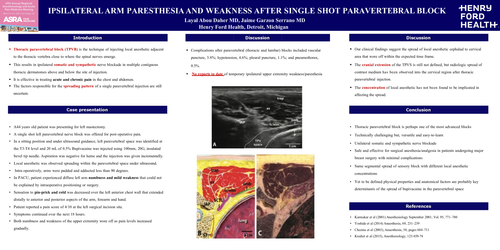
This is a case of a 44 yo ASA2 patient presenting for left mastectomy. A single shot left paravertebral nerve block was offered for post-operative pain as an adjunct to general anesthesia. In PACU, patient experienced diffuse left arm numbness and mild weakness that could not be explained by intraoperative positioning or surgery.
In a sitting position and under ultrasound guidance, left paravertebral space was identified at the T3-T4 level and 20 mL of 0.5% Bupivacaine was injected using 100mm, 20G, insulated bevel tip needle. Aspiration was negative for heme and a single injection was given incrementally. Local anesthetic was observed spreading within the paravertebral space under ultrasound. Intra-operatively, arms were padded and adducted less than 90 degrees. In PACU, sensation to pin-prick and cold was decreased over the left anterior chest wall that extended distally to anterior and posterior aspects of the arm, forearm and hand. Patient reported a pain score of 4/10 at the left surgical incision site. Symptoms continued over the next 18 hours. Both numbness and weakness of the upper extremity wore off as pain levels increased gradually. These clinical findings suggest the spread of local anesthetic cephalad to cervical area that wore off within the expected time frame.
Prospectively evaluated complications after paravertebral (thoracic and lumbar) blocks observed the following frequency of complications: vascular puncture, 3.8%; hypotension, 4.6%; pleural puncture, 1.1%; and pneumothorax, 0.5%. No reports to date of temporary ipsilateral upper extremity weakness as a minor complication. The cranial extension of the TPVS is still not defined, but radiologic spread of contrast medium was observed into the cervical region after thoracic paravertebral injection. The concentration of local anesthetic was not found to be implicated in affecting the spread. Yet to be defined physical properties and anatomical factors are probably key determinants of the spread of bupivacaine in the paravertebral space.