457 posters, 2 videos, 2 audios, 8 topics, 45 sessions, 401 authors, 265 institutions
ePostersLive by SciGen Technologies S.A. All rights reserved.
49th Annual Regional Anesthesiology and Acute Pain Medicine Meeting
March 21-23, 2024 | The Hilton Bayfront San Diego | San Diego, California

5537
STIMULATING PERINEURAL NERVE CATHETER ENTRAPMENT IN THE CONTEXT OF HOME REGIONAL NERVE BLOCK: A CASE REPORT AND LITERATURE REVIEW
Poster Presenter
Authors
Affiliations
Part of Topic
Medically Challenging Cases
Stimulating Perineural Nerve Catheter Entrapment in the context of home regional nerve block: A case report and literature review
Levent Sahin 1, Lindsey Caldwell3, Brendan Patterson3, Rakesh V. Sondekoppam2, Melinda Seering2
1 Faculty, Washington University in St. Louis, Anesthesiology and Pain Medicine, St Louis, MO, USA
2 Faculty, University ofIowa, Anesthesiology and Pain Medicine, Iowa City, IA, USA
3 Faculty, University ofIowa, Orthopedics and Rehabilitation, Iowa City, IA, USA
Short Title: Stimulating Perineural Nerve Catheter Entrapment
Keywords: Stimulating, Perineural, Nerve Catheter, Entrapment
Introduction
Of the many peripheral nerve catheters currently in use for regional anesthesia procedures, stimulating catheters are one among them. Common to all nerve block catheters, stimulating catheters have an associated risks including unintended migration, secondary failure and mechanical issues related to catheter. Here, we describe the clinical presentation and subsequent management of a case of perineural entrapment of stimulating nerve block catheter in a patient with home interscalene nerve catheter identified after home discharge. We further review the evidence on mechanical complications of perineural catheter and their management.
Material Method
Patient informed consent was obtained for this case report. As this case report is devoid of any patient identifiable, it is exempted from IRB review requirements as per University of Iowa Policy.
Results/Case report:
Patient informed consent was obtained for this case report. As this case report is devoid of any patient identifiable, it is exempted from IRB review requirements as per University of Iowa Policy. A 72-year-old female was scheduled for a right reverse total shoulder arthroplasty. On the day of surgery, a stimulating interscalene catheter (Arrow, StimuCath® Peripheral Nerve Catheter, PA, USA) was placed uneventfully under ultrasound guidance preoperatively and a local anesthetic infusion was started through the interscalene catheter postoperatively. Prior to discharging home on POD1, the patient and her husband were educated about using the peripheral nerve catheter pump (ambIT® Ambulatory Infusion Therapy Pump, Avanos, Alpharetta, GA, USA) and removing the catheter when the infusion was complete.
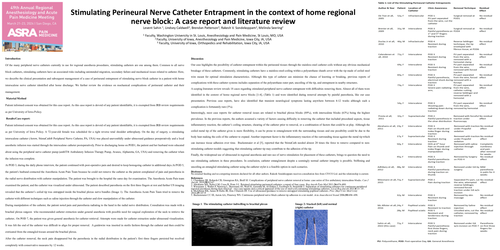
At POD 3, during the daily phone interview, the patient continued with post-operative pain and desired to keep homegoing catheter in additional days.At POD 5, the patient's husband contacted the Anesthesia Acute Pain Team because he could not remove the catheter as the patient complained of pain and paresthesia in the radial nerve distribution with catheter manipulation. The patient was brought to the hospital the same day for examination. The Anesthesia Acute Pain team examined the patient, and the catheter was visualized under ultrasound. The patient described paresthesia on the first three fingers at rest and further US imaging revealed that the catheter’s coiled tip was entrapped inside the brachial plexus nerve bundles (Image 1). The Anesthesia Acute Pain Team tried to remove the catheter with different techniques such as saline injection through the catheter and slow manipulation of the catheter. During manipulation of the catheter, the patient noted pain and paresthesia radiating to the hand in the radial nerve distribution. Consultation was made with a brachial plexus surgeon who recommended catheter extraction under general anesthesia with possible need for surgical exploration of the neck to retrieve the catheter. On POD 7, the patient was given general anesthesia for catheter retrieval. Attempts were made for catheter extraction under ultrasound visualization. It was felt the end of the catheter was difficult to align for proper removal. A guidewire was inserted in sterile fashion through the catheter and then could be extricated from the entangled tissues around the brachial plexus.
After the catheter removal, the neck pain disappeared but the paresthesia in the radial distribution in the patient’s first three fingers persisted but resolved completely with conservative measures by 12 weeks.
Discussion
Our case highlights the possibility of catheter entrapment within the perineural tissues through the stainless-steel catheter coils without any obvious mechanical breakage of these catheters. Commonly, stimulating catheters have a stainless-steel-coiling within a polyurethane sheath cover with the tip made of coiled steel wire meant for optimal stimulation characteristics. Although this type of catheter can minimize the chance of knotting or breaking, previous reports of complications with these catheter systems includes separation of the polyurethane outer part, uncoiling of the tip, and entrapment in nearby structures.
A scoping literature review reveals 18 cases regarding stimulated peripheral nerve catheter entrapment with difficulties removing them. Almost all of them were identified in the context of home regional nerve blocks [1-4], (Table 1) and were identified during removal attempts by painful paresthesia, like our case presentation. Previous case reports, have also identified that transient neurological symptoms lasting anywhere between 4-12 weeks although such a complication is fortunately rare (5%).
Interestingly, most case reports for catheter removal issues are related to brachial plexus blocks (89%), with interscalene blocks (63%) being the highest prevalence. In the previous reports, the authors assumed a variety of factors causing difficulty in removing the catheter that included procedural aspects, tissue inflammatory reaction, the catheter’s coiling structure, shearing of the catheter prior to removal, or a combination of factors that could be at play. Although the coiled metal tip of the catheter gives is more flexibility, it can be prone to entanglement with the surrounding tissues and one possibility could be due to the body heat making the coils of the catheter to expand. Another important factor is the inflammatory reaction of the surrounding tissue against the metal tip which can increase tissue adhesion over time. Buckenmaier et al [5], reported that the StimuCath needed almost 20 times the force to remove compared to non-stimulating catheter models suggesting that stimulating catheter tip may contribute to the adhesion of the tip.
Finally, the widespread use of ultrasound in regional anesthesia and rare use of nerve stimulation for placement of these catheters, brings to question the need to use stimulating catheters in these procedures. In conclusion, catheter entanglement despite a seemingly normal catheter integrity is possible. Stiffening and uncoiling an entangled stimulating catheter using the catheter stylet is a feasible option in such scenarios.
Disclosure
No external funding and no competing interests were declared for all other authors. Rakesh Sondekoppam receives consultation fees from CIVCO Ltd. and the relationship is current.
References
1. Clendenen SR, Robards CB, Greengrass RA, Brull SJ. Complications of peripheral nerve catheter removal at home: case series of five ambulatory interscalene blocks. Can J Anesth. 2010;58:62-67.
2. Abrahams MS, Noles LM, Cross R, Horn J-L. Retained stimulating perineural catheters: a report of four cases. Reg Anesth Pain Med 2011;36:476-480.
3. Wiesmann T, Wallot P, Nentwig L, Beermann AV, Wulf H, Zoremba M, Al-Dahna T, Eschbach D, Steinfeldt T. Separation of stimulating catheters for continuous peripheral regional anesthesia during their removal—two case reports and a critical appraisal of the use of steel-coil containing stimulating catheters. Local Reg Anesth 2015;8:15–19 .
4. McAllister RK, James B Hulin JB, Don J Daniels DJ. Use of ultrasound guidance to remove entrapped stimulating popliteal catheters. Proc (Bayl Univ Med Cent) 2016;29:147-9
5. Buckenmaier CC III, Auton AA, Flournoy WS. Continuous peripheral nerve block catheter tip adhesion in a rat model. Acta Anaesthesiol Scand 2006;50:694–698.