457 posters, 2 videos, 2 audios, 8 topics, 45 sessions, 401 authors, 265 institutions
ePostersLive by SciGen Technologies S.A. All rights reserved.
49th Annual Regional Anesthesiology and Acute Pain Medicine Meeting
March 21-23, 2024 | The Hilton Bayfront San Diego | San Diego, California

5508
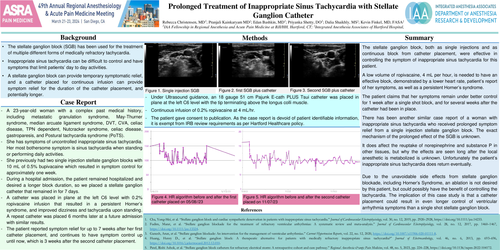
PROLONGED TREATMENT OF INAPPROPRIATE SINUS TACHYCARDIA WITH STELLATE GANGLION CATHETER
Poster Presenter
Authors
Affiliations
Part of Topic
Medically Challenging Cases
Background:
The stellate ganglion block (SGB) has been used for the treatment of multiple different forms of medically refractory tachycardia.
Inappropriate sinus tachycardia can be difficult to control and have symptoms that limit patients’ day to day activities.
A stellate ganglion block can provide temporary symptomatic relief, and a catheter placed for continuous infusion can provide symptom relief for the duration of the catheter placement, and potentially longer.
Case Report:
A 23-year-old woman with a complex past medical history, including metastatic granulation syndrome, May-Thurner syndrome, median arcuate ligament syndrome, DVT, CVA, celiac disease, TPN dependent, Nutcracker syndrome, celiac disease, gastroparesis, and Postural tachycardia syndrome (PoTS).
She has symptoms of uncontrolled inappropriate sinus tachycardia. Her most bothersome symptom is sinus tachycardia when standing or performing daily activities.
She previously had two single injection stellate ganglion blocks with 10 mL of 0.5% bupivacaine which resulted in symptom control for approximately one week.
During a hospital admission, the patient remained hospitalized and desired a longer block duration, so we placed a stellate ganglion catheter that remained in for 7 days.
A catheter was placed in plane at the left C6 level with 0.2% ropivacaine infusion that resulted in a persistent Horner’s syndrome, and improved dizziness and tachycardia upon standing. A repeat catheter was placed 6 months later at a future admission with similar results.
The patient reported symptom relief for up to 7 weeks after her first catheter placement, and continues to have symptom control up until now, which is 3 weeks after the second catheter placement.
Summary:
The stellate ganglion block, both as single injections and as continuous block from catheter placement, were effective in controlling the symptom of inappropriate sinus tachycardia for this patient.
A low volume of ropivacaine, 4 mL per hour, is needed to have an effective block, demonstrated by a lower heart rate, patient’s report of her symptoms, as well as a persistent Horner’s syndrome.
The patient claims that her symptoms remain under better control for 1 week after a single shot block, and for several weeks after the catheter had been in place.
There has been another similar case report of a woman with inappropriate sinus tachycardia who received prolonged symptom relief from a single injection stellate ganglion block. The exact mechanism of the prolonged effect of the SGB is unknown.
It does affect the reuptake of norepinephrine and substance P in other tissues, but why the effects are seen long after the local anesthetic is metabolized is unknown. Unfortunately the patient’s inappropriate sinus tachycardia does return eventually.
Due to the unavoidable side effects from stellate ganglion blockade, including Horner’s Syndrome, an ablation is not desired by this patient, but could possibly have the benefit of controlling the tachycardia. The implication of this case study is that a catheter placement could result in even longer control of ventricular arrhythmia symptoms than a single shot stellateg anglion block.
References:
Cha, Yong‐Mei, et al. “Stellate ganglion block and cardiac sympathetic denervation in patients with inappropriate sinus tachycardia.” Journal of Cardiovascular Electrophysiology, vol. 30, no. 12, 2019, pp. 2920–2928, https://doi.org/10.1111/jce.14233.
Fudim, Marat, et al. “Stellate ganglion blockade for the treatment of refractory ventricular arrhythmias: A systematic review and meta‐analysis.” Journal of Cardiovascular Electrophysiology, vol. 28, no. 12, 2017, pp. 1460–1467, https://doi.org/10.1111/jce.13324.
Ganesh, Arun, et al. “Stellate ganglion blockade: An intervention for the management of ventricular arrhythmias.” Current Hypertension Reports, vol. 22, no. 12, 2020, https://doi.org/10.1007/s11906-020-01111-8.
Huang, Henry D., et al. “Stellate ganglion block: A therapeutic alternative for patients with medically refractory inappropriate sinus tachycardia?” Journal of Electrocardiology, vol. 46, no. 6, 2013, pp. 693–696, https://doi.org/10.1016/j.jelectrocard.2012.12.010.
Patel, Rishi Ashok, et al. “Stellate ganglion block catheters for refractory electrical storm: A retrospective cohort and care pathway.” Regional Anesthesia & Pain Medicine, vol. 48, no. 5, 2023, pp. 224–228, https://doi.org/10.1136/rapm-2022-1041 72.