457 posters, 2 videos, 2 audios, 8 topics, 45 sessions, 401 authors, 265 institutions
ePostersLive by SciGen Technologies S.A. All rights reserved.
49th Annual Regional Anesthesiology and Acute Pain Medicine Meeting
March 21-23, 2024 | The Hilton Bayfront San Diego | San Diego, California

5382
MANAGEMENT OF ACUTE PAIN IN A PATIENT WITH A LEFT UPPER EXTREMITY MYXOID SOFT TISSUE SARCOMA REQUIRING FOREQUARTER AMPUTATION
Poster Presenter
Authors
Affiliations
Part of Topic
Medically Challenging Cases
Management of acute pain in a patient with left upper extremity myxoid soft tissue sarcoma requiring forequarter amputation
PATIENT PRESENTATION
•79yo female with PMH of HTN, CKD, DM2, hypothyroidism, breast cancer, pulmonary embolism
•Presented with left upper extremity pain (6/10) predominantly in the deltoid region and fingers
•CT/MRI revealed an expansile myxoid soft tissue sarcoma centered on the left glenohumeral joint extending to the mid/distal proximal humeral diaphysis, largest portion measuring 8.2x6x20cm.
•Associated bony erosion of distal clavicle, acromion, scapula, humeral head and neck with complete involvement of rotator cuff musculature.
•Surgical plan: left upper extremity forequarter amputation with acute pain consultation
PREOPERATIVE MANAGEMENT
•Single-shot supraclavicular and superficial cervical plexus blocks to provide coverage of left deltoid/shoulder and hand pain
•Interscalene nerve catheter with bupivacaine 0.25% PIB 6mL/hr, PCA 4mL/30min
•Catheter exchanged on hospital day 7 due to concerns for insertion site infection
•Multimodal oral pain medications
•Satisfactory pain control à 1-3/10
INTRA/POSTOPERATIVE MANAGEMENT
•Preoperative T1-2 epidural catheter placed
•Forequarter amputation of left upper extremity with free total fillet of forearm myocutaneous flap with vascular anastomosis to the axillary vessels with targeted reinnervation
•Epidural catheter proved unusable intraoperatively and was subsequently removed
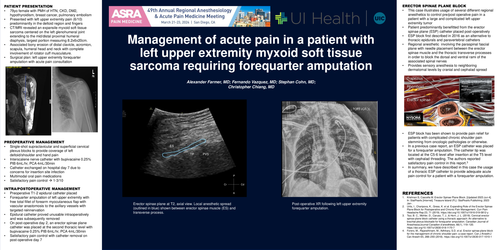
•On post-operative day 2, an erector spinae plane catheter was placed at the second thoracic level with bupivacaine 0.25% PIB 6mL/hr, PCA 4mL/30min
•Satisfactory pain control with catheter removal on post-operative day 7
ERECTOR SPINAE PLANE BLOCK
•This case illustrates usage of several different regional anesthetics to control pre/post operative pain in a patient with a large and complicated left upper extremity tumor
•Patient predominantly benefitted from the erector spinae plane (ESP) catheter placed post-operatively
•ESP block first described in 2016 as an alternative to thoracic epidurals and paravertebral catheters
•Regional anesthetic involving the paraspinal fascial plane with needle placement between the erector spinae muscle and the thoracic transverse processes in order to block the dorsal and ventral rami of the associated spinal nerves
•Provides sensory anesthesia to neighboring dermatomal levels by cranial and cephalad spread
•ESP block has been shown to provide pain relief for patients with complicated chronic shoulder pain stemming from oncologic pathologies or otherwise.
•In a previous case report, an ESP catheter was placed for a forequarter amputation. The catheter tip was located at the C5-6 level after insertion at the T5 level with cephalad threading. The authors reported satisfactory pain control in this report.3
•In summary, we have described in this case the usage of a thoracic ESP catheter to provide adequate acute pain control for a patient with a forequarter amputation.