457 posters, 2 videos, 2 audios, 8 topics, 45 sessions, 401 authors, 265 institutions
ePostersLive by SciGen Technologies S.A. All rights reserved.
49th Annual Regional Anesthesiology and Acute Pain Medicine Meeting
March 21-23, 2024 | The Hilton Bayfront San Diego | San Diego, California

5292
CONSIDERATION FOR NEURAXIAL PROCEDURES FOLLOWING REVERSAL OF ANTICOAGULATION WITH PROTHROMBIN COMPLEX CONCENTRATE
Poster Presenter
Authors
Affiliations
Part of Topic
Medically Challenging Cases
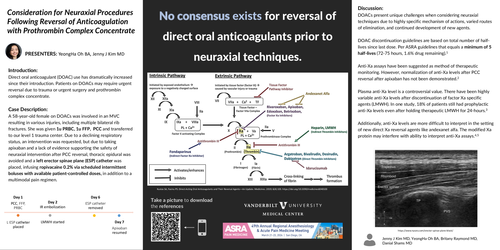
Introduction: Direct oral anticoagulant (DOAC) use has dramatically increased since their introduction. Patients on DOACs may require urgent reversal due to trauma or urgent surgery and prothrombin complex concentrate. No consensus exists for reversal of direct oral anticoagulants prior to neuraxial techniques.
Case Description: A 58-year-old female on DOACs was involved in an MVC resulting in various injuries, including multiple bilateral rib fractures. She was given 1u PRBC, 1u FFP, PCC and transferred to our level 1 trauma center. Due to a declining respiratory status, an intervention was requested, but due to taking apixaban and a lack of evidence supporting the safety of neuraxial intervention after PCC reversal, thoracic epidural was avoided and a left erector spinae plane (ESP) catheter was placed, infusing ropivacaine 0.2% via scheduled intermittent boluses with available patient-controlled doses, in addition to a multimodal pain regimen.
Discussion:
DOACs present unique challenges when considering neuraxial techniques due to highly specific mechanism of actions, varied routes of elimination, and continued development of new agents.
DOAC discontinuation guidelines are based on total number of half-lives since last dose. Per ASRA guidelines that equals a minimum of 5 half-lives (72-75 hours, 1.6% drug remaining).1
Anti-Xa assays have been suggested as method of therapeutic monitoring. However, normalization of anti-Xa levels after PCC reversal after apixaban has not been demonstrated.2
Plasma anti-Xa level is a controversial value. There have been highly variable anti-Xa levels after discontinuation of factor Xa specific agents (LMWH). In one study, 18% of patients still had prophylactic anti-Xa levels even after holding therapeutic LMWH for 24-hours.3
Additionally, anti-Xa levels are more difficult to interpret in the setting of new direct Xa reversal agents like andexanet alfa. The modified Xa protein may interfere with ability to interpret anti-Xa assays.4,5