457 posters, 2 videos, 2 audios, 8 topics, 45 sessions, 401 authors, 265 institutions
ePostersLive by SciGen Technologies S.A. All rights reserved.
49th Annual Regional Anesthesiology and Acute Pain Medicine Meeting
March 21-23, 2024 | The Hilton Bayfront San Diego | San Diego, California

5091
TRANSVERSUS ABDOMINIS PLANE BLOCK AS MAJOR COMPONENT FOR PAIN MANAGEMENT OF NECROTIZING ABDOMINAL WALL CARCINOMA
Poster Presenter
Authors
Affiliations
Part of Topic
Medically Challenging Cases
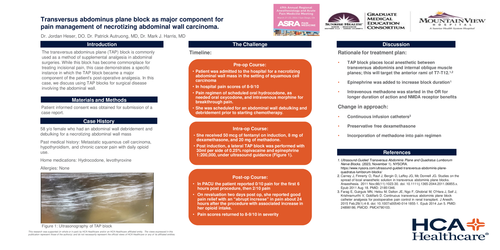
Transversus abdominus plane block as major component for pain management of necrotizing abdominal wall carcinoma.
Introduction:
The transversus abdominus plane (TAP) block is commonly used as a method of supplemental analgesia in abdominal surgeries. While this block has become commonplace for treating incisional pain, this case demonstrates a specific instance in which the TAP block became a major component of the patient’s post-operative analgesia. In this case, we discuss using TAP blocks for surgical disease involving the abdominal wall.
Materials and Methods:
Patient informed consent was obtained for submission of a case report.
Case History:
58 y/o female who had an abdominal wall debridement and debulking for a necrotizing abdominal wall mass
Past medical history: Metastatic squamous cell carcinoma, hypothyroidism, and chronic cancer pain with daily opioid use.
Home medications: Hydrocodone, levothyroxine
Allergies: None
The Challenge
Pre-op Course:
Intra-op Course:
Post-op Course:
Rationale for treatment plan:
TAP block places local anesthetic between transversus abdominis and internal oblique muscle planes; this will target the anterior rami of T7-T12.1,2
Epinephrine was added to increase block duration1
Intravenous methadone was started in the OR for longer duration of action and NMDA receptor benefits
Change in approach:
Continuous infusion catheters3
Preservative free dexamethasone
Incorporation of methadone into pain regimen