457 posters, 2 videos, 2 audios, 8 topics, 45 sessions, 401 authors, 265 institutions
ePostersLive by SciGen Technologies S.A. All rights reserved.
49th Annual Regional Anesthesiology and Acute Pain Medicine Meeting
March 21-23, 2024 | The Hilton Bayfront San Diego | San Diego, California

5386
CASE REPORT: USE OF SPINAL CORD STIMULATION FOR THE TREATMENT OF REFRACTORY VASOSPASTIC ANGINA
Poster Presenter
Authors
Affiliations
Part of Topic
Medically Challenging Cases
Use of Spinal Cord Stimulation for the Treatment of Refractory Vasospastic Angina: Case Report
Nikita Patole1, Boshra Louka MD FACC FSCAI2 , Rano Faltas MD1
iSpine Clinics Maple Grove, Minnesota1, Interventional Cardiology, Willis Knighton Medical Center, Shreveport, Louisiana2
-
Established treatment options for vasospastic angina
-
Long-acting nitroglycerins1 and Calcium channel blockers2
-
Ranolazine- sodium channel inhibitor
-
Percutaneous revascularizations/surgical options for vasospastic angina are limited given absence of focal mechanical obstructive lesions.
-
Spinal cord stimulation at the T1 to T2 level has been effective and more commonly used for management of refractory angina pectoris
Patient: 46 year old Female
-
Angina pectoris presenting for several months limiting her independence as well as activities of daily living.
-
The patient sought treatment in Emergency Departments several times within the span of 6 months.
-
The patient was evaluated by cardiology
-
Angiogram showed widely patent coronary arteries and exercise electrocardiogram was normal.
-
Angiogram and response of coronary vasoconstriction to intracoronary acetylcholine led to the diagnosis of vasospastic angina without atherosclerotic coronary artery disease.
-
Failed Treatments
-
Enhanced External Counterpulsation (EECP) therapy for two months with benefit but not resolution of her symptoms.
-
Medication therapy: several opioids, NSAIDs, muscle relaxants, neuropathic medications, Low Dose Naltrexone, and a ketamine compound cream. Only Nitroglycerin 0.4MG, in combination with a calcium channel antagonist (Cardizem, Diltiazem), partially relieved her symptoms.
-
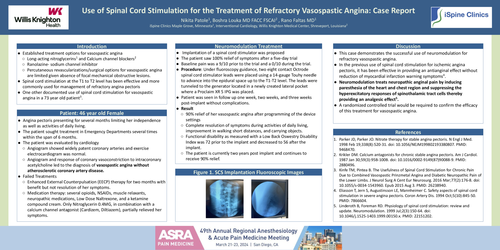
Implantation of a spinal cord stimulator was proposed
-
The patient saw 100% relief of symptoms after a five-day trial
-
Baseline pain was a 9/10 prior to the trial and a 0/10 during the trial.
-
Procedure: Under fluoroscopy guidance, two eight contact Octrode spinal cord stimulator leads were placed using a 14-gauge Touhy needle to advance into the epidural space up to the T1-T2 level. The leads were tunneled to the generator located in a newly created lateral pocket where a Proclaim XR 5 IPG was placed.
-
Patient was seen in follow up one week, two weeks, and three weeks post-implant without complications.
-
Result
-
90% relief of her vasospastic angina after programming of the device settings
-
Complete resolution of symptoms during activities of daily living, improvement in walking short distances, and carrying objects.
-
Functional disability as measured with a Low Back Oswestry Disability Index was 72 prior to the implant and decreased to 56 after the implant.
-
The patient is currently two years post implant and continues to receive 90% relief.
-
This case demonstrates the successful use of neuromodulation for refractory vasospastic angina.
-
In the previous use of spinal cord stimulation for ischemic angina pectoris, it has been effective in providing an antianginal effect without reduction of myocardial infarction warning symptoms4.
-
Neuromodulation treats neuropathic anginal pain by inducing paresthesia of the heart and chest region and suppressing the hyperexcitatory responses of spinothalamic tract cells thereby providing an analgesic effect5.
-
A randomized controlled trial would be required to confirm the efficacy of this treatment for vasospastic angina.
-
Parker JD, Parker JO. Nitrate therapy for stable angina pectoris. N Engl J Med. 1998 Feb 19;338(8):520-31. doi: 10.1056/NEJM199802193380807. PMID: 9468470.
-
Krikler DM. Calcium antagonists for chronic stable angina pectoris. Am J Cardiol. 1987 Jan 30;59(3):95B-100B. doi: 10.1016/0002-9149(87)90088-9. PMID: 2880496.
-
Kinfe TM, Pintea B. The Usefulness of Spinal Cord Stimulation for Chronic Pain Due to Combined Vasospastic Prinzmetal Angina and Diabetic Neuropathic Pain of the Lower Limbs. J Neurol Surg A Cent Eur Neurosurg. 2016 Mar;77(2):176-8. doi: 10.1055/s-0034-1543960. Epub 2015 Aug 3. PMID: 26238940.
-
Eliasson T, Jern S, Augustinsson LE, Mannheimer C. Safety aspects of spinal cord stimulation in severe angina pectoris. Coron Artery Dis. 1994 Oct;5(10):845-50. PMID: 7866604.
-
Linderoth B, Foreman RD. Physiology of spinal cord stimulation: review and update. Neuromodulation. 1999 Jul;2(3):150-64. doi: 10.1046/j.1525-1403.1999.00150.x. PMID: 22151202.