457 posters, 2 videos, 2 audios, 8 topics, 45 sessions, 401 authors, 265 institutions
ePostersLive by SciGen Technologies S.A. All rights reserved.
49th Annual Regional Anesthesiology and Acute Pain Medicine Meeting
March 21-23, 2024 | The Hilton Bayfront San Diego | San Diego, California

5641
INTERSCALENE BRACHIAL PLEXUS BLOCK FOLLOWING CRYOABLATION OF SHOULDER FIBROMATOSIS
Poster Presenter
Authors
Affiliations
Part of Topic
Medically Challenging Cases
Introduction:
Interscalene brachial plexus block (ISB) has been utilized as an effective analgesic technique in the management of postoperative pain following shoulder and proximal humerus surgery. Desmoid type fibromatosis of major joints tend to cause high pain due to multiple factors like, surrounding neurovascular compression and the space occupying nature of tumor itself. With literature showing high effectiveness, cryoablation remains to be a single best treatment for extra abdominal fibromatosis, and general anesthesia being the preferred technique, but the long- term pain management is always controversial.[i] This concept was demonstrated in our case described below, in which ISB served as an effective strategy to manage both chronic and post-procedural pain following a shoulder cryoablation procedure.
Material & Methods:
Informed consent for regional anesthesia and inclusion in this case report was obtained. As this case report is devoid of any patient identifiable information, it is exempt from IRB review requirements per our institutional policy.
Case Report:
46 y/o female with progressive right anterior shoulder desmoid fibromatosis who had been undergoing serial cryoablation treatments to manage chronic pain and tumor burden following an initial failed treatment course of chemotherapy and surgical resection. Following her initial two cryoablation procedures, the patient noticed improvement with ROM but continued to describe significant pain progressing to the axilla and upper arm. In the outpatient setting, the patient was placed on a regimen gabapentin 300 mg TID and oxycodone IR 15 mg q4h PRN. Even with maximal utilization of her analgesic regimen daily, the patient expressed uncontrolled pain (8/10) over her right shoulder and axilla as well as lateral chest wall that ultimately limited her daily ability to perform functional activities.
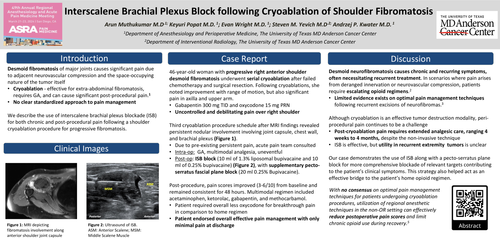
The patient presented to the interventional radiology suite for her third cryoablation procedure following MRI findings demonstrating persistent nodular involvement along the humeral, anterior joint capsule, and adjacent to the scapular spine in addition to distal tumor in the chest wall and upper arm, invading the brachial plexus (Figure 1). Given her history of persistent pain and anticipated pain following the cryoablation procedure, the acute pain team was consulted to evaluate for regional blockade of the upper extremity and/or chest wall to improve peri-procedural recovery.
For the cryoablation procedure, the patient underwent general anesthesia with endotracheal intubation and was administered a combination of acetaminophen, ketorolac, fentanyl, hydromorphone, and dexmedetomidine infusion for multimodal analgesia. In the immediate recovery period following the procedure, and right-sided ultrasound guided interscalene brachial plexus block was performed using a injectate combination of 10 ml liposomal bupivacaine 1.3% and 10 ml 0.25% bupivacaine. For additional chest wall and axillary coverage, a single shot pecto-serratus fascial plant block was performed with 20 ml 0.25% bupivacaine. (Figure 2).
Following the procedure, the patient endorsed pain scores ranging from 3-6/10 over the course of 48 hours leading to discharge. In addition to a multimodal regimen of acetaminophen, ketorolac, gabapentin, and methocarbamol PRN, For POD0, she used oxycodone 15 mg x3, on POD1 oxycodone 15 mg x7, and on POD2 oxycodone 15 mg x3. This overall was less than her home daily dose of 6 tablets of Oxycodone 15 mg with no significant relief. On the day of discharge, the patient endorsed effective analgesic management with the regional blockade during her recovery and was discharged on her home regimen with a pain score of 2/10. During her recovery, she only required 1 dose of hydromorphone IV 0.5 mg as rescue for pain.
Discussion:
Neurofibromatosis, particularly of the desmoid nature, is characterized by chronic and recurring symptoms, often necessitating prolonged and recurrent treatment. In cases where desmoid tumors reoccur, causing pain through deranged innervation or neurovascular compression, patients frequently require multiple opioid doses, leading to escalating tolerance and dependence.[ii] This poses a risk for opioid dependence and lower threshold of opioid overdoing in opioid-naïve individuals. Limited evidence exists on managing pain following recurrent excisions of non-abdominal neurofibromas, especially in closed spaces where inevitable recurrent pain is likely.[iii]
As cryoablation emerges as a newer tumor destruction modality, pain thresholds remain constant compared to conventional excision, despite its less invasive nature. Cryoablation, focusing on the tumor itself, requires continuous analgesic support throughout the recovery period, ranging from 4 weeks to 4 months, despite the comparatively non-invasive technique employed.[iv] Although ISB is known for effective analgesia in perioperative shoulder surgeries, its efficacy in recurrent tumor cases is not well-studied. Challenges with recurrent tumors include prior analgesic dosages, deranged nerve innervation from multiple cryoablations, and variable patient tolerance thresholds with opioid-seeking behavior.[v] Addressing these challenges is crucial, and our case demonstrates the effectiveness of supplementing ISB with long-acting anesthetics like liposomal bupivacaine. ISB along with pecto-serratus block gives a wider nerve block target which might be useful in tumor related as well as cryoablation related peri-operative pain, acting as an effective bridge for opioids. With no consensus describing best pain management for patients undergoing this procedure, this approach resulted in significantly lower postoperative pain scores and minimal opioid requirements during recovery.[vi]
Our case signifies the importance of utilizing a ISB for post-procedural as well as chronic pain in recurrent non-desmoid neurofibroma-related cryoablation procedures. Future studies, while evaluating the effectiveness of ISB in shoulder cryoablation procedures, should explore the efficacy and feasibility of catheter-based anesthetic supplementation for achieving long-term pain-free recovery.
[i] Mandel JE, Kim D, Yarmohammadi H, Ziv E, Keohan ML, D'Angelo SP, Gounder MM, Whiting K, Qin LX, Singer S, Crago AM, Erinjeri JP. Percutaneous Cryoablation Provides Disease Control for Extra-Abdominal Desmoid-Type Fibromatosis Comparable with Surgical Resection. Ann Surg Oncol. 2022 Jan;29(1):640-648.
[ii] Bektas M, Bell T, Khan S, Tumminello B, Fernandez MM, Heyes C, Oton AB. Desmoid Tumors: A Comprehensive Review. Adv Ther. 2023 Sep;40(9):3697-3722.
[iii] Bellampalli SS, Khanna R. Towards a neurobiological understanding of pain in neurofibromatosis type 1: mechanisms and implications for treatment. Pain. 2019 May;160(5):1007-1018.
[iv] Redifer Tremblay K, Lea WB, Neilson JC, King DM, Tutton SM. Percutaneous cryoablation for the treatment of extra-abdominal desmoid tumors. J Surg Oncol. 2019 Sep;120(3):366-375.
[v] Arthur J, Edwards T, Reddy S, Nguyen K, Hui D, Yennu S, Park M, Liu D, Bruera E. Outcomes of a Specialized Interdisciplinary Approach for Patients with Cancer with Aberrant Opioid-Related Behavior. Oncologist. 2018 Feb;23(2):263-270.
[vi] Saltiel S, Bize PE, Goetti P, Gallusser N, Cherix S, Denys A, Becce F, Tsoumakidou G. Cryoablation of Extra-Abdominal Desmoid Tumors: A Single-Center Experience with Literature Review. Diagnostics (Basel). 2020 Aug 4;10(8):556.