457 posters, 2 videos, 2 audios, 8 topics, 45 sessions, 401 authors, 265 institutions
ePostersLive by SciGen Technologies S.A. All rights reserved.
49th Annual Regional Anesthesiology and Acute Pain Medicine Meeting
March 21-23, 2024 | The Hilton Bayfront San Diego | San Diego, California

5592
PERIOPERATIVE OPIOID-FREE ANALGESIA FOR REVISION TOTAL HIP ARTHROPLASTY IN A PATIENT WITH A HISTORY OF SUBSTANCE ABUSE.
Poster Presenter
Authors
Affiliations
Part of Topic
Medically Challenging Cases
Perioperative Opioid-Free Analgesia for Revision Total Hip Arthroplasty in a Patient with a History of Substance Abuse.
Robert L. Owen, M.D., Mitchell J. Kerfeld, M.D., Jason K. Panchamia, D.O., David A. Olsen, M.D., Adam W. Amundson, M.D.
Mayo Clinic, Department of Anesthesiology and Perioperative Medicine
INTRODUCTION
- Complimentary regional nerve blocks can synergistically provide sufficient analgesic coverage.
- A single peripheral nerve block may fail to cover all the involved sensory nerves of complexly innervated anatomical locations such as the hip joint.
CASE
- 69M presented for revision hip arthroplasty after unsuccessful treatment of recurrent periprosthetic joint infections.
- ASA III, DM2, moderate aortic valve stenosis, CKD3, class III obesity
- History of opioid abuse (in remission)
- Patient requested an opioid-free anesthetic
- Pre-Op:
- Acetaminophen 1 g PO, celecoxib 200 mg PO
- Suprainguinal fascia iliaca (SIFI) block performed:
- 35 cc total of 0.25% bupivacaine with 1:200,000 epinephrine
- Pericapsular nerve group (PENG) block performed:
- 15 cc total of 0.25% bupivacaine with 1:200,000 epinephrine
- Intra-Op:
- Total Intravenous Anesthesia
- 80 mg of IV ketamine (total)
- Surgeon-performed local infiltration analgesia (LIA):
- Ropivacaine 150 mg, Ketorolac 15 mg
- Post-Op:
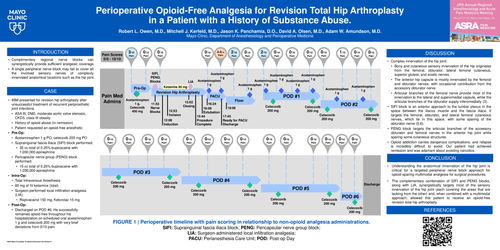
- Discharged on POD #6. He successfully remained opioid-free throughout his hospitalization on scheduled oral acetaminophen 1 g and celecoxib 200 mg with very brief deviations from 0/10 pain.
FIGURE 1 | Perioperative timeline with pain scoring in relationship to non-opioid analgesia administrations.
- SIFI: Suprainguinal fascia iliaca block;
- PENG: Pericapsular nerve group block;
- LIA: Surgeon-administered local infiltration analgesia;
- PACU: Perianesthesia Care Unit;
- POD: Post-op Day
DISCUSSION
- Complex innervation of the hip joint:
- Bony and cutaneous sensory innervation of the hip originates from the femoral, obturator, lateral femoral cutaneous, superior gluteal, and sciatic nerves.
- The anterior hip capsule is mostly innervated by the femoral and obturator nerves, with occasional contribution from the accessory obturator nerve.
- Articular branches of the femoral nerve provide most of the innervation to the lateral and superomedial capsule, while the articular branches of the obturator supply inferomedially (3).
- SIFI block is an anterior approach to the lumbar plexus in the space between the iliacus muscle and the fascia iliaca. It targets the femoral, obturator, and lateral femoral cutaneous nerves, which lie in this space, with some sparing of the obturator nerve (5,6).
- PENG block targets the articular branches of the accessory obturator and femoral nerves in the anterior hip joint while sparing some cutaneous structures.
- Opioid addiction carries dangerous complications, and relapse is incredibly difficult to avoid. Our patient had achieved remission and was adamant about avoiding narcotics for his surgery.
CONCLUSION
- Understanding the anatomical innervation of the hip joint is critical for a targeted peripheral nerve block approach for opioid-sparing multimodal analgesia for surgical procedures.
- The complementary combination of SIFI and PENG blocks, along with LIA, synergistically targets most of the sensory innervation of the hip joint (each covering the areas that are lacking from the other) and, when combined with a multimodal approach, allowed this patient to receive an opioid-free revision total hip arthroplasty.
REFERENCES
- Girón-Arango, Laura, et al. Pericapsular nerve group (PENG) block for hip fracture. Regional Anesthesia & Pain Medicine. 2018;43.8:859-863.
- Desmet M, Vermeylen K, Van Herreweghe I, Carlier L, Soetens F, Lambrecht S, Croes K, Pottel H, Van de Velde M. A longitudinal supra-inguinal fascia iliaca compartment block reduces morphine consumption after total hip arthroplasty. Regional Anesthesia & Pain Medicine. 2017 May 1;42(3):327-33.
- Short, Anthony J., et al. Anatomic study of innervation of the anterior hip capsule: implication for image-guided intervention. Regional Anesthesia & Pain Medicine. 2018;43.2:186-192.
- Kukreja P, Avila A, Northern T, Dangle J, Kolli S, Kalagara H. A retrospective case series of pericapsular nerve group (PENG) block for primary versus revision total hip arthroplasty analgesia. Cureus. 2020 May 19;12(5).
- Song, Jiannan, et al. Fascia iliaca compartment block for analgesia in total hip replacement: A randomized controlled study protocol. Medicine. 2020;99.37.
- Zhang, Xiao-yan, Jian-bao Ma. The efficacy of fascia iliaca compartment block for pain control after total hip arthroplasty: a meta-analysis. Journal of orthopaedic surgery and research. 2019;14.1:1-10.
- Bullock WM, Yalamuri SM, Gregory SH, et al. Ultrasound-guided suprainguinal fascia iliaca technique provides benefit as an analgesic adjunct for patients undergoing total hip arthroplasty. J Ultrasound Med. 2017;36:433–438.
- Johnson RL, Amundson AW, Abdel MP, Sviggum HP, Mabry TM, Mantilla CB, Schroeder DR, Pagnano MW, Kopp SL. Continuous posterior lumbar plexus nerve block versus periarticular injection with ropivacaine or liposomal bupivacaine for total hip arthroplasty: a three-arm randomized clinical trial. JBJS. 2017 Nov 1;99(21):1836-45.
- Hah JM, Bateman BT, Ratliff J, Curtin C, Sun E. Chronic opioid use after surgery: implications for perioperative management in the face of the opioid epidemic. Anesthesia and analgesia. 2017 Nov;125(5):1733.
- Sun EC, Darnall BD, Baker LC, Mackey S. Incidence of and risk factors for chronic opioid use among opioid-naive patients in the postoperative period. JAMA internal medicine. 2016 Sep 1;176(9):1286-93.
- Mason MJ, Golladay G, Jiranek W, et al. Depression Moderates the Relationship Between Pain and the Nonmedical Use of Opioid Medication Among Adult Outpatients. J Addict Med. Nov-Dec 2016;10(6):408–413.
- Ben-Ari A, Chansky H, Rozet I. Preoperative Opioid Use Is Associated with Early Revision After Total Knee Arthroplasty: A Study of Male Patients Treated in the Veterans Affairs System. J Bone Joint Surg Am. January 04 2017;99(1):1–9.