457 posters, 2 videos, 2 audios, 8 topics, 45 sessions, 401 authors, 265 institutions
ePostersLive by SciGen Technologies S.A. All rights reserved.
49th Annual Regional Anesthesiology and Acute Pain Medicine Meeting
March 21-23, 2024 | The Hilton Bayfront San Diego | San Diego, California

5545
NERVE STIMULATION FOR ASSISTING IN ANTERIOR SUPRASCAPULAR NERVE BLOCKADE
Poster Presenter
Authors
Affiliations
Part of Topic
Medically Challenging Cases
Video
Nerve Stimulation in Anterior Suprascapular Nerve Blockade
David Corpman MD, Chetna Prasad MD MBA, Balkarn Thind MD, David Auyong MD
Virginia Mason Medical Center, Seattle, WA
Introduction
- Interscalene block remains gold standard regional anesthetic for shoulder surgeries but associated hemi-diaphragmatic weakness is poorly tolerated in patients with certain conditions.1
- “SPA” block is an alternative brachial plexus block to mitigate phrenic nerve involvement with targeted blockade of anterior Suprascapular nerve and the Posterior and Anterior divisions of the superior trunk.2
- Catheter placement at anterior suprascapular nerve provides non inferior analgesia compared to interscalene block with significantly better preservation of pulmonary function.3, 4
- Anterior suprascapular block for shoulder surgery requires identification of the suprascapular nerve to ensure local anesthetic is deposited near the correct structure.
- We present nerve stimulation performed in addition to standard practice of ultrasound guidance to aid anatomic localization of suprascapular nerve blockade.
Case Report
- 62 y/o M (BMI 38 kg/m2) with history of chronic obstructive pulmonary disease, tobacco use disorder, coronary artery disease on aspirin, type 2 diabetes mellitus and hypertension presented for right arthroscopic rotator cuff repair.
- Single shot suprascapular nerve block selected over catheter due to tenuous respiratory status and post operative follow-up concerns.
- Block performed under ultrasound guidance and nerve stimulation with 15 mL of 0.5% ropivacaine.
- Surgery notable for aborted rotator cuff repair due to poor tissue quality, but arthroscopic debridement and immediate post operative care were uneventful.
Nerve Stimulation and Relevant Anatomy
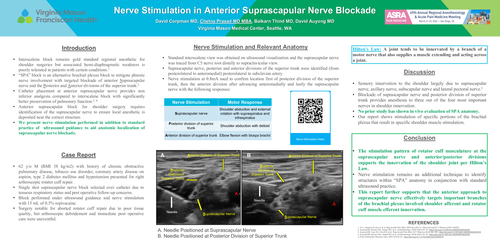
- Standard interscalene view was obtained on ultrasound visualization and the suprascapular nerve was traced from C5 nerve root distally to supraclavicular view.
- Suprascapular nerve, posterior and anterior divisions of the superior trunk were identified (from posterolateral to anteromedial) posterolateral to subclavian artery.
- Nerve stimulation at 0.8mA used to confirm location first of posterior division of the superior trunk, then the anterior division after advancing anteromedially and lastly the suprascapular nerve with the following responses: Suprascapular Nerve – shoulder abduction and external rotation with supraspinatus and infraspinatus; posterior division of superior trunk – should abduction with deltoid; anterior division of superior trunk – elbow flexion with biceps brachii.
Discussion
- Hilton’s Law: A joint tends to be innervated by a branch of a motor nerve that also supplies a muscle extending and acting across a joint.
- Sensory innervation to the shoulder largely due to suprascapular nerve, axillary nerve, subscapular nerve and lateral pectoral nerve.5
- Blockade of suprascapular nerve and posterior division of superior trunk provides anesthesia to three out of the four most important nerves in shoulder innervation.
- No prior study has shown in vivo evaluation of SPA anatomy.
- Our report shows stimulation of specific portions of the brachial plexus that result in specific shoulder muscle stimulation.
Conclusion
- The stimulation pattern of rotator cuff musculature at the suprascapular nerve and anterior/posterior divisions supports the innervation of the shoulder joint per Hilton’s Law.
- Nerve stimulation remains an additional technique to identify structures within “SPA” anatomy in conjunction with standard ultrasound practice.
- This report further supports that the anterior approach to suprascapular nerve effectively targets important branches of the brachial plexus involved shoulder afferent and rotator cuff muscle efferent innervation.