457 posters, 2 videos, 2 audios, 8 topics, 45 sessions, 401 authors, 265 institutions
ePostersLive by SciGen Technologies S.A. All rights reserved.
49th Annual Regional Anesthesiology and Acute Pain Medicine Meeting
March 21-23, 2024 | The Hilton Bayfront San Diego | San Diego, California

5170
A ROAD LESS TRAVELED: A CASE REPORT ON ANTERIOR SCIATIC NERVE BLOCK IN A PATIENT WITH CONTRACTURES
Poster Presenter
Authors
Affiliations
Part of Topic
Medically Challenging Cases
A Road Less Traveled: A Case Report on Anterior Sciatic Nerve Block in a Patient with Contractures
Lee Tian, M.D. (1), Eric Ly, M.D. (2), Vendhan Ramanujam, M.D. (3), Mark Kendall, M.D. (4)
Department of Anesthesiology, The Warren Alpert Medical School of Brown University, Providence, Rhode Island
Introduction
•Sciatic nerve provides both motor and sensory innervation to a majority of the lower extremity.
•Sciatic nerve block, when used in conjunction with a femoral nerve block, can offer powerful post-operative pain control for lower extremity surgeries.
•Posterior approach for sciatic nerve block is most often used but has its limitations, particularly in patients with physiological or pathological compromises.
•This case report serves as an example that alternate approaches exist in sciatic nerve block, and they are useful when posterior approach is not feasible or difficult.
Case Report
•63-year-old male with history of right sided hemiplegia, subarachnoid hematoma, and chronic right lower extremity osteomyelitis presented for right above knee amputation.
•On exam, patients presented with right sided neurological symptoms including contractures of the right lower extremity.
•Femoral and sciatic nerve block were planned for post-operative analgesia and general anesthesia with endotracheal tube was requested for complete paralysis of the right lower extremity.
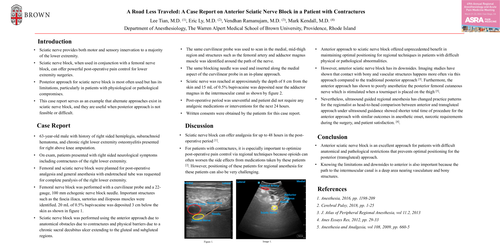
•Femoral nerve block was performed with a curvilinear probe and a 22-gauge, 100 mm echogenic nerve block needle. Important structures such as the fascia iliaca, sartorius and iliopsoas muscles were identified. 20 mL of 0.5% bupivacaine was deposited 3 cm below the skin as shown in figure 1.
•Sciatic nerve block was performed using the anterior approach due to anatomical obstacles due to contractures and physical barriers due to a chronic sacral decubitus ulcer extending to the gluteal and subgluteal regions.
•The same curvilinear probe was used to scan in the medial, mid-thigh region and structures such as the femoral artery and adductor magnus muscle was identified around the path of the nerve.
•The same blocking needle was used and inserted along the medial aspect of the curvilinear probe in an in-plane approach.
•Sciatic nerve was reached at approximately the depth of 8 cm from the skin and 15 mL of 0.5% bupivacaine was deposited near the adductor magnus in the intermuscular canal as shown by figure 2.
•Post-operative period was uneventful and patient did not require any analgesic medications or interventions for the next 24 hours.
•Written consents were obtained by the patients for this case report.
Discussion
•Sciatic nerve block can offer analgesia for up to 48 hours in the post-operative period [1].
•For patients with contractures, it is especially important to optimize post-operative pain control via regional techniques because opioids can often worsen the side effects from medications taken by these patients [2]. However, positioning of these patients for regional anesthesia for these patients can also be very challenging.
•Anterior approach to sciatic nerve block offered unprecedented benefit in maintaining optimal positioning for regional techniques in patients with difficult physical or pathological abnormalities.
•However, anterior sciatic nerve block has its downsides. Imaging studies have shown that contact with bony and vascular structures happens more often via this approach compared to the traditional posterior approach [3]. Furthermore, the anterior approach has shown to poorly anesthetize the posterior femoral cutaneous nerve which is stimulated when a tourniquet is placed on the thigh [5].
•Nevertheless, ultrasound guided regional anesthesia has changed practice patterns for the regionalist as head-to-head comparison between anterior and transgluteal approach under ultrasound guidance showed shorter total time of procedure for the anterior approach with similar outcomes in anesthetic onset, narcotic requirements during the surgery, and patient satisfaction. [4].
Conclusion
•Anterior sciatic nerve block is an excellent approach for patients with difficult anatomical and pathological restrictions that prevents optimal positioning for the posterior (transgluteal) approach.
•Knowing the limitations and downsides to anterior is also important because the path to the intermuscular canal is a deep area nearing vasculature and bony structures.
References
1. Anesthesia, 2016, pp. 1198-209
2. Cerebral Palsy, 2018, pp. 1-25
3. J. Atlas of Peripheral Regional Anesthesia, vol 11.2, 2013
4. Anes Essays Res, 2012, pp. 29-33
5. Anesthesia and Analgesia, vol 108, 2009, pp. 660-5