457 posters, 2 videos, 2 audios, 8 topics, 45 sessions, 401 authors, 265 institutions
ePostersLive by SciGen Technologies S.A. All rights reserved.
49th Annual Regional Anesthesiology and Acute Pain Medicine Meeting
March 21-23, 2024 | The Hilton Bayfront San Diego | San Diego, California

5373
INTRAOPERATIVE DIRECT PLACEMENT OF BRACHIAL PLEXUS CATHETER FOR FOREQUARTER AMPUTATION ANALGESIA
Poster Presenter
Authors
Affiliations
Part of Topic
Medically Challenging Cases
Intraoperative Direct Placement of Brachial Plexus Catheter for Forequarter Amputation Analgesia
INTRODUCTION
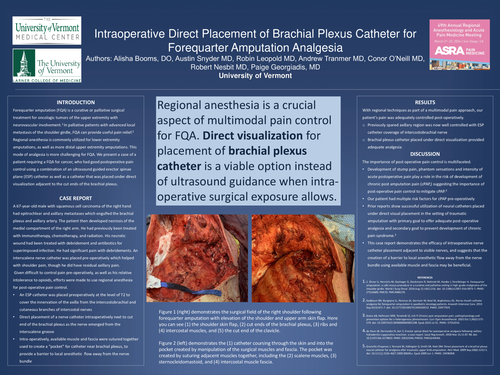
Forequarter amputation (FQA) is a curative or palliative surgical treatment for oncologic tumors of the upper extremity with neurovascular involvement.1 In palliative patients with advanced local metastasis of the shoulder girdle, FQA can provide useful pain relief.2 Regional anesthesia is commonly utilized for lower extremity amputations, as well as more distal upper extremity amputations. This mode of analgesia is more challenging for FQA. We present a case of a patient requiring a FQA for cancer, who had good postoperative pain control using a combination of an ultrasound guided erector spinae plane (ESP) catheter as well as a catheter that was placed under direct visualization adjacent to the cut ends of the brachial plexus.
CASE REPORT
A 67-year-old male with squamous cell carcinoma of the right hand had epitrochlear and axillary metastases which engulfed the brachial plexus and axillary artery. The patient then developed necrosis of the medial compartment of the right arm. He had previously been treated with immunotherapy, chemotherapy, and radiation. His necrotic wound had been treated with debridement and antibiotics for superimposed infection. He had significant pain with debridements. An interscalene nerve catheter was placed pre-operatively which helped with shoulder pain, though he did have residual axillary pain.
Given difficult to control pain pre-operatively, as well as his relative intolerance to opioids, efforts were made to use regional anesthesia for post-operative pain control.