457 posters, 2 videos, 2 audios, 8 topics, 45 sessions, 401 authors, 265 institutions
ePostersLive by SciGen Technologies S.A. All rights reserved.
49th Annual Regional Anesthesiology and Acute Pain Medicine Meeting
March 21-23, 2024 | The Hilton Bayfront San Diego | San Diego, California

5283
LIPOSOMAL BUPIVACAINE ADMINISTRATION IN ALPHA-GAL SYNDROME: AVOIDING A POTENTIALLY BAA-AD REACTION
Poster Presenter
Authors
Affiliations
Part of Topic
Medically Challenging Cases
LIPOSOMAL BUPIVACAINE ADMINISTRATION IN ALPHA-GAL SYNDROME: AVOIDING A POTENTIALLY BAA-AD REACTION
Ali Seferovich MD, Everett Fox MD, Leon Grinman DO, Nabil Elkassabany MD, Brett Elmore MD
Twitter: @elmorbr @nelkassabany @uvaregional
INTRODUCTION
•Here we describe a patient with a known history of alpha-gal syndrome (AGS) who underwent a hemorrhoidectomy procedure. The surgical team initially planned to administer Exparel® (liposomal bupivacaine)1 for postoperative pain management. However, due to the patient’s alpha-gal allergy, and after discussion with both the anesthesiologist and the pharmacist, reconsideration of the analgesic plan was undertaken, leading to the decision to forego the use of Exparel®. The safety profile of Exparel® administration in this population has not been reported, so the authors sought to assess other institutions’ experience via a brief survey of the Regional Anesthesiology Fellowship Directors Association (RAFDA).
CASE REPORT
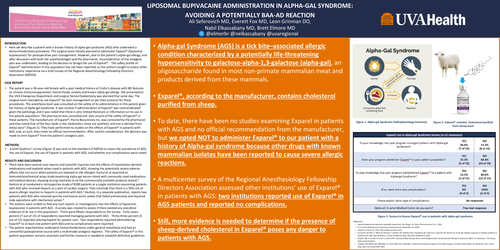
•The patient was a 36-year-old female with a past medical history of Crohn’s disease with IBS features on chronic immunosuppression, hemorrhoids, anxiety and known alpha-gal allergy. She presented to the UVA Emergency Department and surgical hemorrhoidectomy was planned that same day. The surgical team intended to use Exparel® for pain management as per their protocol for these procedures. The anesthesia team was consulted on the safety of its administration in this patient given her history of alpha-gal syndrome. It was unclear if administration of Exparel® was contraindicated given the pathology and it was noted that there is very limited literature or information on its use in this patient population. The pharmacist was consulted and also unsure of the safety of Exparel® in these patients. The manufacturer of Exparel®, Pacira Biosciences Inc, was contacted by the pharmacist and they noted that of the four lipids in the medication, three are synthetic and one is derived from sheep wool 2 (Figure 2). They have performed no studies on the effects of Exparel® in patients with AGS, and, as such, they make no official recommendation. After careful consideration, the decision was made to omit Exparel® from the patient’s analgesic plan.
METHODS
•A brief Qualtrics3 survey (Figure 3) was sent to the members of RAFDA to assess the prevalence of AGS, the use of Exparel, the use of Exparel in patients with AGS, and whether any complications were noted.
RESULTS AND DISCUSSION
•There have been several case reports and scientific inquiries into the effects of mammalian-derived medications and implants when used in patients with AGS, showing the potentially severe adverse effects that can occur when patients are exposed to the allergen. Kuravi et al reported an immunohistochemical assay study examining alpha-gal serum mixed with commonly used medications and medical devices, showing strong reactivity to all the commercially available products tested.4 Harkins et al conducted a retrospective study of 8189 patients at a single institution examining patients with AGS who received heparin as a part of cardiac surgery. They conclude that there is a 50% risk of severe allergic reaction to heparin in patients with AGS.5 Harkins, in a separate publication, reports two patients with AGS who received porcine and bovine aortic valves that failed prematurely and required redo operations with mechanical valves.6
•The authors were unable to find any such reports or investigations into the effects of liposomal bupivacaine in patients with AGS. A survey was created to assess if there existed any anecdotal evidence of its use in this population. There were fifteen respondents to the survey. Forty seven percent (7 out of 15) of respondents reported managing patients with AGS. Thirty-three percent (5 out of 15) reported utilizing Exparel for patient care. Two respondents reported administering Exparel® to at least one patient with AGS and no complications were reported.
•The patient reported here underwent hemorrhoidectomy under general anesthesia and had an uneventful postoperative course with a multimodal analgesic regimen. The safety of Exparel® in this patient population remains uncertain and further research is needed to establish definitive guidelines.
SUMMARY
•Alpha-gal Syndrome (AGS) is a tick bite–associated allergic condition characterized by a potentially life-threatening hypersensitivity to galactose-alpha-1,3-galactose (alpha-gal), an oligosaccharide found in most non-primate mammalian meat and products derived from these mammals.
•Exparel®, according to the manufacturer, contains cholesterol purified from sheep.
•To date, there have been no studies examining Exparel in patients with AGS and no official recommendation from the manufacturer, but we opted NOTto administer Exparel® to our patient with a history of Alpha-gal syndrome because other drugs with known mammalian isolates have been reported to cause severe allergic reactions.
•A multicenter survey of the Regional Anesthesiology Fellowship Directors Association assessed other institutions’ use of Exparel® in patients with AGS: two institutions reported use of Exparel® in AGS patients and reportedno complications.
•Still, more evidence is needed to determine if the presence of sheep-derived cholesterol in Exparel® posesany danger to patients with AGS.
References:
1.Exparel (bupivacaine liposome injectable suspension). San Diego, CA. Pacira Pharmaceutical, Inc.; 2022.
2.R Ha, Pacira Biosciences Inc (personal communication, November 21, 2023)
3. Qualtrics, Provo, UT, USA. https://www.qualtrics.com
4.Kuravi KV, Sorrells LT, Nellis JR, Rahman F, Walters AH, Matheny RG, Choudhary SK, Ayares DL, Commins SP, Bianchi JR, Turek JW. Allergic response to medical products in patients with alpha-gal syndrome. J Thorac Cardiovasc Surg. 2022 Dec;164(6):e411-e424.
5.Hawkins RB, Frischtak HL, Kron IL, Ghanta RK. Premature Bioprosthetic Aortic Valve Degeneration Associated with Allergy to Galactose-Alpha-1,3-Galactose. J Card Surg. 2016 Jul;31(7):446-8.
6. Hawkins RB, Wilson JM, Mehaffey JH, Platts-Mills TAE, Ailawadi G. Safety of Intravenous Heparin for Cardiac Surgery in Patients With Alpha-Gal Syndrome. Ann Thorac Surg. 2021 Jun;111(6):1991-1997.