457 posters, 2 videos, 2 audios, 8 topics, 45 sessions, 401 authors, 265 institutions
ePostersLive by SciGen Technologies S.A. All rights reserved.
49th Annual Regional Anesthesiology and Acute Pain Medicine Meeting
March 21-23, 2024 | The Hilton Bayfront San Diego | San Diego, California

5261
THE USE OF PROXIMAL INTERCOSTAL NERVE BLOCK CATHETER FOR ACUTE LEFT VENTRICULAR ASSIST DEVICE ASSOCIATED CHEST WALL PAIN
Poster Presenter
Authors
Affiliations
Part of Topic
Medically Challenging Cases
The use of Proximal Intercostal Nerve Block Catheter for Acute
Left Ventricular Assist Device Associated Chest Wall Pain
Introduction
The escalating prevalence of advanced heart failure 1 has led
to an increased reliance on left ventricular assist devices
( as both bridge to heart transplant and destination
therapy 2 3 LVAD treatment has been shown to improve
survival 4 however, the acute and chronic pain which can
result from LVADs has been understudied
The most recent LVAD device, the Heartmate 3 (
Plymouth NM), comes in a single size There are no limitations
for smaller patients in terms of candidacy for LVAD as current
retrospective data suggest similar functional outcomes, and
devices has been placed successfully in patients as small as
22 kg 5 6 7
Proximal intercostal nerve blocks ( under ultrasound
guidance provide targeted analgesia to specific dermatomes
along the thoracic wall and provide a safer alternative when
anticoagulation could prohibit neuraxial techniques such as
epidural or paravertebral analgesia
Intercostal nerve blocks have been used to manage acute
postoperative pain following LVAD placement via thoracotomy
9 However, to our knowledge, no one has described acute
non incisional chest wall pain associated with LVAD placement
In this case report, we describe the development of acute non
incisional chest wall pain, at the level of the LVAD device, and
successful treatment with PICB nerve block catheter
Case Report
A petite 30 year old female 5 5 BSA 1 73 m 2 with a history of familial
cardiomyopathy complicated by peripartum non ischemic cardiomyopathy requiring
LVAD placement (Heartmate 3 via a median sternotomy due to worsening
symptoms of heart failure The post operative pain service was consulted on POD# 8
due to persistent poorly controlled pain in a sharp band radiating internally along the
torso (correlating with T 7 dermatome) isolated on the left side of her chest
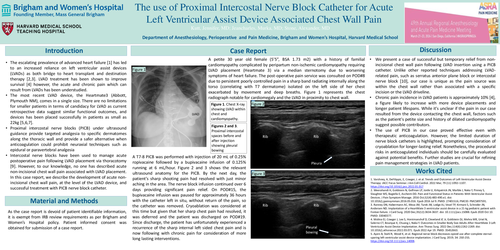
exacerbated by movement and deep breaths Figure 1 represents the chest
radiograph notable for cardiomegaly and the LVAD in proximity to chest wall
A T 7 8 PICB was performed with injection of 20 mL of 0 25
ropivacaine followed by a bupivacaine infusion of 0 125
running at 6 mL/hour Figure 2 and 3 shows the relevant
ultrasound anatomy for the PICB By the next day, the
patient’s sharp shooting pain had resolved with just minor
aching in the area The nerve block infusion continued over 6
days providing significant pain relief On POD# 15 the
bupivacaine infusion was paused for approximately 36 hours
with the catheter left in situ, without return of the pain, so
the catheter was removed Cryoablation was considered at
this time but given that her sharp chest pain had resolved, it
was deferred and the patient was discharged on POD# 19
Since discharge, the patient has unfortunately experienced a
recurrence of the sharp internal left sided chest pain and is
now following with chronic pain for consideration of more
long lasting interventions