Loading...

457 posters, 2 videos, 2 audios, 8 topics, 45 sessions, 401 authors, 265 institutions

ePostersLive by SciGen Technologies S.A. All rights reserved.

49th Annual Regional Anesthesiology and Acute Pain Medicine Meeting

March 21-23, 2024 | The Hilton Bayfront San Diego | San Diego, California

49th Annual Regional Anesthesiology and Acute Pain Medicine Meeting banner

5628

A CENTURY OLD NEURAXIAL TECHNIQUE FOR A CENTENARIAN PRESENTING WITH A HIP FRACTURE
Poster Presenter

Juan Acosta

Part of Topic

Medically Challenging Cases

A Century old neuraxial technique for a Centenarian presenting with a hip fracture

Introduction

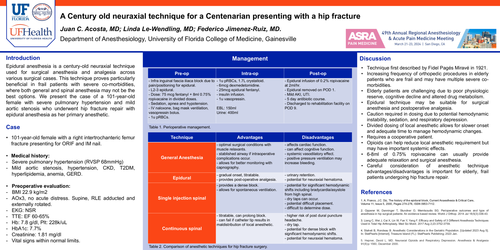
Epidural anesthesia is a century-old neuraxial technique used for surgical anesthesia and analgesia across various surgical cases. This technique proves particularly beneficial in frail patients with severe co-morbidities, where both general and spinal anesthesia may not be the best options. We present the case of a 101-year-old female with severe pulmonary hypertension and mild aortic stenosis who underwent hip fracture repair with epidural anesthesia as her primary anesthetic.

Case

•101-year-old female with a right intertrochanteric femur fracture presenting for ORIF and IM nail.


•Medical history: 
-Severe pulmonary hypertension (RVSP 68mmHg)
-Mild aortic stenosis, hypertension, CKD, T2DM, hyperlipidemia, anemia, GERD. 


•Preoperative evaluation: 

-   BMI 22.9 kg/m2

-AOx3, no acute distress. Supine, RLE adducted and externally rotated.
-EKG: NSR
-TTE: EF 60-65%
-Hb: 7.8 g/dl, Plt: 228k/uL
-HbA1c: 7.7%
-Creatinine: 1.81 mg/dl
-Vital signs within normal limits.

Discussion

 
•Technique first described by Fidel Pagés Miravé in 1921.
•Increasing frequency of orthopedic procedures in elderly patients who are frail and may have multiple severe co-morbidities.
•Elderly patients are challenging due to poor physiologic reserve, cognitive decline and altered drug metabolism.
•Epidural technique may be suitable for surgical anesthesia and postoperative analgesia.
•Caution required in dosing due to potential hemodynamic instability, sedation, and respiratory depression.
•Divided dosing of local anesthetic allows for slower onset and adequate time to manage hemodynamic changes.
•Requires a cooperative patient.
•Opioids can help reduce local anesthetic requirement but may have important systemic effects.
•6-8ml of 0.75% ropivacaine can usually provide adequate relaxation and surgical anesthesia.
•Careful consideration of anesthetic technique advantages/disadvantages is important for elderly, frail patients undergoing hip fracture repair.

References


1. A. Franco, J.C. Diz, The history of the epidural block, Current Anaesthesia & Critical Care,

Volume 11, Issue 5, 2000, Pages 274-276, ISSN 0953-7112.


2. Opperer M, Danninger T, Stundner O, Memtsoudis SG. Perioperative outcomes and type of anesthesia in hip surgical patients: An evidence based review. World J Orthop. 2014 Jul 18;5(3):336-43.


3. Liang C, Wei J, Cai X, Lin W, Fan Y, Yang F. Efficacy and Safety of 3 Different Anesthesia Techniques Used in Total Hip Arthroplasty. Med Sci Monit. 2017 Aug 2;23:3752-3759.


4. Staheli B, Rondeau B. Anesthetic Considerations in the Geriatric Population. [Updated 2023 Aug 5]. In: StatPearls[Internet]. Treasure Island (FL): StatPearls Publishing; 2023 Jan.


5. Hepner, David L. MD. Neuraxial Opioids and Respiratory Depression. Anesthesia & Analgesia 91(6):p 1560, December 2000.

49th Annual Regional Anesthesiology and Acute Pain Medicine Meeting » banner
Copyright © 2015-2026, ePostersLive® SciGen is a registered trademark of SciGen Technologies S.A. Patent pending.

This website and third-party tools we use rely on cookies for the best user experience. By selecting "I agree", you agree to cookie usage as described in our Privacy Policy.