457 posters, 2 videos, 2 audios, 8 topics, 45 sessions, 401 authors, 265 institutions
ePostersLive by SciGen Technologies S.A. All rights reserved.
49th Annual Regional Anesthesiology and Acute Pain Medicine Meeting
March 21-23, 2024 | The Hilton Bayfront San Diego | San Diego, California

5598
IT WASN’T ME! POST-OP NERVE INJURY FOLLOWING AN ACHILLES REPAIR
Poster Presenter
Authors
Affiliations
Part of Topic
Medically Challenging Cases
Introduction
•Peripheral Nerve Blocks (PNBs) are effective in mitigating post-surgical pain
•PNBs are not without risk and can result in temporary or permanent nerve injury
•Use of ultrasound is now ubiquitous in the placement of PNBs
•Ultrasound can also be effectively used in the diagnostic work-up of a nerve injury
•Case report below is one such example in which identification of a nerve injury’s source was aided by ultrasound evaluation
Materials and Methods
•Case report is devoid of patient identifiable information and is exempt from IRB review requirements as per policies of UNC’s Office of Human Research Ethics
•Patient informed consent was obtained for submission of this case report
Case Report
•Healthy male in his mid-20s sustained Achilles tear in a sports-related injury
•Underwent repair via tendoscopically-assisted percutaneous approach under general anesthesia with preoperative popliteal sciatic nerve catheter placed for post-operative analgesia; discharged home with elastomeric pain pump x3 days
•Following uneventful recovery in splint for ~2 weeks, splint was removed at post-op follow-up; no neurological issues documented prior to or at that time
•Over next few days, patient experienced worsening foot pain, difficulty bearing weight and plantar numbness, which precipitated Emergency Room visit
•Reevaluated by surgeon and list of potential causes included nerve compression from localized swelling, nerve block related nerve injury, tourniquet palsy despite brief tourniquet time, and nerve entrapment from suture, among others
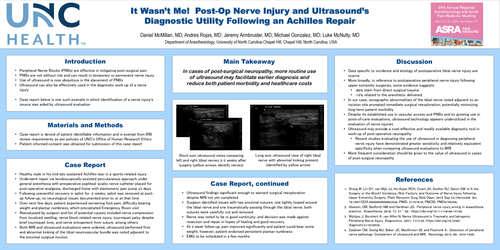
•Both MRI and ultrasound evaluations were ordered; ultrasound performed first and abnormal kinking of the tibial neurovascular bundle was noted adjacent to the proximal surgical incision
•Ultrasound findings significant enough to warrant surgical reexploration despite MRI not yet completed
•Surgeon identified issues with two proximal sutures: one tightly looped around the tibial nerve and one traumatically passing through the tibial nerve; both sutures were carefully cut and removed
•Nerve was noted to be in good continuity, and decision was made against resection and repair in hopes of healing and good recovery
•At 2 week follow-up, pain improved significantly and patient could bear some weight; however, patient endorsed persistent plantar numbness
•EMG to be scheduled in a few months
Discussion
•Data specific to incidence and etiology of postoperative tibial nerve injury are scarce
•More broadly, in reference to postoperative peripheral nerve injury following upper extremity surgeries, some evidence suggests:
•~80% stem from direct surgical trauma
•~15% related to the anesthetic delivered
•In our case, sonographic abnormalities of the tibial nerve noted adjacent to an incision site prompted immediate surgical reexploration, potentially minimizing long-term patient morbidity
•Despite its established use in vascular access and PNBs and its growing use in point-of-care evaluations, ultrasound technology appears underutilized in the evaluation of nerve injuries
•Ultrasound may provide a cost-effective and readily available diagnostic tool in work-up of post-operative neuropathy
•Recent studies evaluating the use of ultrasound in diagnosing peripheral nerve injury have demonstrated greater sensitivity and relatively equivalent specificity when comparing ultrasound evaluations to MRI
•More frequent consideration should be given to the value of ultrasound in cases of post-surgical neuropathy
References
1.Droog W, Lin DY, van Wijk JJ, Ho-Asjoe RCH, Coert JH, Stolker RJ, Galvin EM. Is It the Surgery or the Block? Incidence, Risk Factors, and Outcome of Nerve Injury following Upper Extremity Surgery. Plast Reconstr Surg Glob Open. 2019 Sep 25;7(9):e2458. doi: 10.1097/GOX.0000000000002458. PMID: 31741818; PMCID: PMC6799396.
2.Hewson, DW, Bedforth NM and Hardman JG. Peripheral nerve injury arising in anaesthesia practice. Anaesthesia, 2018, 73: 51 – 60. https://doi.org/10.1111/anae.14140.
3.Wijntjes J, Borchert A, van Alfen N. Nerve Ultrasound in Traumatic and Iatrogenic Peripheral Nerve Injury. Diagnostics. 2021; 11(1):30. https://doi.org/10.3390/diagnostics11010030.
4.Zaidman CM, Seelig MJ, Baker JC, MacKinnon SE and Pestronk A. Detection of peripheral nerve pathology: Comparison of ultrasound and MRI. Neurology 2013, 80: 1634–1640.