457 posters, 2 videos, 2 audios, 8 topics, 45 sessions, 401 authors, 265 institutions
ePostersLive by SciGen Technologies S.A. All rights reserved.
49th Annual Regional Anesthesiology and Acute Pain Medicine Meeting
March 21-23, 2024 | The Hilton Bayfront San Diego | San Diego, California

5643
COMBINED ERECTOR SPINAE, INTERSCALENE, AND SUPRACLAVICULAR NERVE BLOCKS FOR SCAPULAR SPINE SURGERY
Poster Presenter
Authors
Affiliations
Part of Topic
Medically Challenging Cases
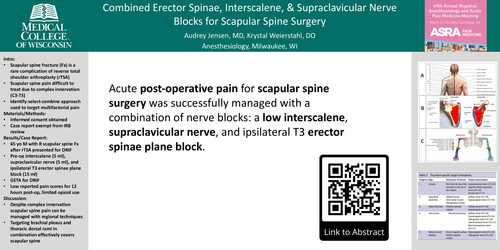
Combined Erector Spinae, Interscalene, and Supraclavicular Nerve Blocks for Scapular Spine Surgery
Audrey Jensen, MD, Krystal Weierstahl DO
Medical College of Wisconsin, Milwaukee, WI
Introduction:
Stress fractures of the shoulder girdle are an uncommon, but well-known complication after reverse total shoulder arthroplasty (rTSA). The most common subset of these fractures are acromial and scapular spine fractures with a reported incidence of 3.1-10%.[1] Surgeries involving the scapular spine can be challenging to target with a regional technique due to the complexity of scapular innervation.
A regional technique for surgery involving the scapula can be challenging due to the complex innervation of the scapula. It requires coverage of the overlying dermatomes, underlying myotomes, and osteotomes of the scapula itself. This can be difficult to target with a single technique since its innervation origin ranges from C3 to T5 which spans both the brachial plexus and thoracic dorsal rami. In these circumstances, the “identify-select-combine” approach of regional anesthesia has been described as a tool for choosing an analgesic approach.[2] First identify the potential pain generating sources of the surgery such as surgical incision, soft tissue damage, bony microfractures, inflammation. Next select a regional technique to target those sources. Finally combine selected targeted blocks to maximize analgesia.
Materials/Methods:
As the case report is devoid of any patient identifying information, it is exempt from IRB review as per the Medical College of Wisconsin policy.
Results/Case Report:
The patient is a 65-year-old male with a past medical history significant for stable CAD, HTN, HLD, and T2DM who presented for an open reduction internal fixation of scapular spine fracture. The patient had previously undergone a reverse total shoulder arthroplasty on the same side several months prior and had poor pain control after initial surgery. Three months after his surgery, the patient was raking leaves in his yard when he developed acute pain and inability to lift his right arm. Imaging revealed a displaced fracture of the right acromian. He was found to have a fracture of his acromian. He was scheduled for an open reduction internal reduction of the right scapula spine. Regional anesthesia was requested for this surgery to post-operative pain control.
In the preoperative holding area, a low interscalene block was done under ultrasound targeting C5, C6, & C7 nerve roots (5 ml). In the same view, the supraclavicular nerve was also targeted via injection between middle scalene and sternocleidomastoid within the fascial plane (5 ml). Finally, an ipsilateral erector spinae plane block at the level of T3 (15 ml).
The patient proceeded to the operating room where he underwent general endotracheal anesthesia and repair of his fracture. A posterior incision was made along the scapular spine. The patient tolerated the procedure well with minimal narcotics. He was then extubated and taken to recovery. At the twenty-four hour recheck, the patient was reporting excellent pain control for the first 12 hours after surgery until the block started to wear off. In first 12 hours after surgery, patient had very limited pain and very little opioid use with high level of analgesic satisfaction.
Discussion:
Scapula surgery for acute fractures is uncommon since most are treated with conservative management, however there is emerging support for surgical correction to improve mobility and quality of life, especially in the elderly population.[3] As ORIF of the scapular spine becomes more common, it is helpful to have a multimodal analgesic approach that includes a regional technique for surgery. Since the scapular innervation is derived from both the brachial plexus and the dorsal rami of the spinal nerves it can be challenging to block with a single injection. A combination approach can be very effective. For surgery of the acromian and scapular spine, we had analgesic success with a combination technique which included an interscalene, T3 erector spinae, and supraclavicular nerve block.
References:
[1] Mayne IP, Bell SN, Wright W, Coghlan JA. Acromial and scapular spine fractures after reverse total shoulder arthroplasty. Shoulder Elbow. 2016 Apr;8(2):90-100. doi: 10.1177/1758573216628783. Epub 2016 Jan 25. PMID: 27583005; PMCID: PMC4950466.
[1] Sonawane K, Balavenkatasubramanian J, Dixit H, et al. Regional anesthesia for scapular fracture surgery: an educational review of anatomy and techniques. Regional Anesthesia & Pain Medicine 2021;46:344-349.
[1] Toft F, Moro F. Does ORIF of rare scapular spine fractures sustained after reverse shoulder arthroplasty benefit elderly patients? A case-series appraisal. Orthop Traumatol Surg Res. 2019 Dec;105(8):1521-1528. doi: 10.1016/j.otsr.2019.07.023. Epub 2019 Oct 25. PMID: 31669549.
[1] Mayne IP, Bell SN, Wright W, Coghlan JA. Acromial and scapular spine fractures after reverse total shoulder arthroplasty. Shoulder Elbow. 2016 Apr;8(2):90-100. doi: 10.1177/1758573216628783. Epub 2016 Jan 25. PMID: 27583005; PMCID: PMC4950466.
[2] Sonawane K, Balavenkatasubramanian J, Dixit H, et al. Regional anesthesia for scapular fracture surgery: an educational review of anatomy and techniques. Regional Anesthesia & Pain Medicine 2021;46:344-349.
[3] Toft F, Moro F. Does ORIF of rare scapular spine fractures sustained after reverse shoulder arthroplasty benefit elderly patients? A case-series appraisal. Orthop Traumatol Surg Res. 2019 Dec;105(8):1521-1528. doi: 10.1016/j.otsr.2019.07.023. Epub 2019 Oct 25. PMID: 31669549.