457 posters, 2 videos, 2 audios, 8 topics, 45 sessions, 401 authors, 265 institutions
ePostersLive by SciGen Technologies S.A. All rights reserved.
49th Annual Regional Anesthesiology and Acute Pain Medicine Meeting
March 21-23, 2024 | The Hilton Bayfront San Diego | San Diego, California

5229
CONTINUOUS COSTOCLAVICULAR PERIPHERAL NERVE CATHETER (PNC) FOR REPEAT PRIMARY ANESTHETIC
Poster Presenter
Authors
Affiliations
Part of Topic
Medically Challenging Cases
Continuous Costoclavicular Peripheral Nerve Catheter (PNC) for Repeat Primary Anesthetic
Background
Patients with significant pulmonary comorbidities requiring upper extremity surgery present many unique challenges.
High risk of:
• Requiring mechanical ventilation • Declining respiratorystatus
• Hemidiaphragmatic paralysiswith
brachial plexus nerve blocks
Case Description
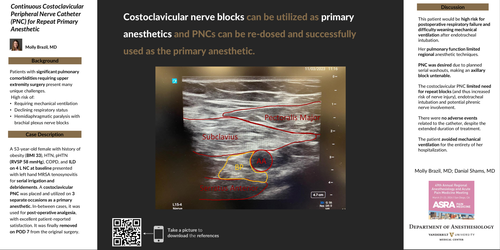
A 53-year-old female with history of obesity (BMI 33), HTN, pHTN (RVSP 58 mmHg), COPD, and ILD on 4 L NC at baseline presented with left hand MRSA tenosynovitis for serial irrigation and debridements. A costoclavicular PNC was placed and utilized on 3 separate occasions as a primary anesthetic. In-between cases, it was used for post-operative analgesia, with excellent patient-reported satisfaction. It was finally removed on POD 7 from the original surgery.
Discussion
This patient would be high risk for postoperative respiratory failure and difficulty weaning mechanical ventilation after endotracheal intubation. Her pulmonary function limited regional anesthetic techniques. PNC was desired due to planned serial washouts, making an axillary block untenable. The costoclavicular PNC limited need for repeat blocks (and thus increased risk of nerve injury), endotracheal intubation and potential phrenic nerve involvement. There were no adverse events related to the catheter, despite the extended duration of treatment. The patient avoided mechanical ventilation for the entirety of her hospitalization.