457 posters, 2 videos, 2 audios, 8 topics, 45 sessions, 401 authors, 265 institutions
ePostersLive by SciGen Technologies S.A. All rights reserved.
49th Annual Regional Anesthesiology and Acute Pain Medicine Meeting
March 21-23, 2024 | The Hilton Bayfront San Diego | San Diego, California

5603
SUBCOSTAL TRANSVERSUS ABDOMINAL PLANE BLOCK FOR POSTOPERATIVE CHEST TUBE PAIN AFTER CARDIAC SURGERY
Poster Presenter
Authors
Affiliations
Part of Topic
Medically Challenging Cases
Subcostal Transversus Abdominal Plane Block for Postoperative Chest Tube Pain After Cardiac Surgery: A Case Report
Emma Rousakis, MD, Alastair E. Moody, MD, Jacob Whittle, MD, Jacob Brandenburg, MD, and Bridger Bach, MD
Department of Anesthesiology, University of Utah Health Sciences Center, Salt Lake City, Utah
Introduction
Inadequate postoperative analgesia has significant effects on patient morbidity, in the form of functional impairment, pulmonary complications, longer hospital stay, and transformation to chronic pain, among many others (1, 2). Postoperative pain specifically for cardiac surgical patients is often substantial, due to sternotomy incision sites, chest tubes, and vascular cannulation sites (2,3). Postoperative pain limits the goals of deep breathing, coughing, and early mobilization, which attempt to prevent pulmonary complications (5). The mainstay of postoperative analgesia for this patient population has typically centered on opioid therapy, with concerns for heparinization limiting regional techniques (3). However, current efforts towards early extubation have redirected attention to methods that may have the potential to avoid the respiratory depression that may occur with opioid treatment (3). Regional techniques have been employed to assist with specific postoperative pain concerns in this population, including transversus thoracic plane block for sternotomy site (3,4). Epigastric pain due to subxiphoid chest tubes contributes to postoperative pain significantly and should be considered when developing a pain management plan (3,4,5). This case report describes the utilization of bilateral oblique subcostal transversus abdominus plane (OSTAP) blocks for refractory chest tube insertion site pain in a post-cardiac surgery patient.
Case Report
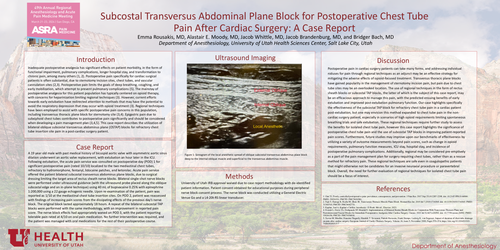
A 19 year old male with past medical history of bicuspid aortic valve with asymmetric aortic sinus dilation underwent an aortic valve replacement, with extubation an hour later in the ICU. Following extubation, the acute pain service was consulted on postoperative day (POD) 1 for significant postoperative pain (rated 10/10) localized to the two mediastinal chest tubes, refractory to hydromorphone, fentanyl, lidocaine patches, and ketorolac. Acute pain service offered the patient bilateral subcostal transversus abdominus plane blocks, due to surgical dressing limiting the target area of rectus sheath nerve blocks. Bilateral single-shot nerve blocks were performed under ultrasound guidance (with the ultrasound probe placed along the oblique subcostal edge and an in-plane technique) using 40 mL of bupivacaine 0.25% with epinephrine 1:200,000 using a 22 gauge echogenic needle. Upon re-examination of the patient, pain was reported as 1/10 at the mediastinal chest tube insertion sites. On POD 2, patient was reassessed with findings of increasing pain scores from the dissipating effects of the previous day’s nerve block. The original block lasted approximately 18 hours. A repeat of the bilateral subcostal TAP blocks were performed with the same methodology, with an improvement in reported pain score. The nerve block effects had appropriately waned on POD 3, with the patient reporting tolerable pain rated at 4/10 on oral pain medication. No further intervention was required, and the patient was managed with oral medications for the rest of their postoperative course.
Methods
University of Utah IRB approval waived due to case report methodology with de-identified patient information. Patient consent obtained for educational purposes during peripheral nerve block consent process. The nerve block was conducted utilizing a General Electric Venue Go and a L4-20t-RS linear transducer.
Discussion
Postoperative pain in cardiac surgery patients can take many forms, and addressing individual niduses for pain through regional techniques as an adjunct may be an effective strategy for mitigating the adverse effects of opioid-focused treatment. Transversus thoracic plane blocks have gained popularity in the management of sternotomy incision pain, but pain due to chest tube sites may be an overlooked location. The use of regional techniques in the form of rectus sheath blocks or subcostal TAP blocks, the latter of which is the subject of this case report, may be an efficacious approach to manage this pain, with the predicted ensuing benefits of early extubation and improved post-extubation pulmonary function. Our case highlights specifically the effectiveness of the subcostal TAP block for refractory chest tube pain in a cardiac patient post-extubation, but one may envision this method expanded to chest tube pain in the non-cardiac surgery patient, especially in scenarios of high opioid requirements limiting spontaneous breathing trials and safe extubation. These regional techniques require further study to assess the benefits for isolated chest tube pain, however this case report highlights the significance of postoperative chest tube pain and the use of subcostal TAP blocks in improving patient-reported pain scores. Furthermore, future studies may improve upon our benchmarks of effectiveness by utilizing a variety of outcome measurements beyond pain scores, such as change in opioid requirements, pulmonary function measures, ICU stay, hospital stay, and incidence of postoperative pulmonary complications. Additionally, regional may be considered pre-emptively as a part of the pain management plan for surgery requiring chest tubes, rather than as a rescue method for refractory pain. These regional techniques are safe even in coagulopathic patients that might otherwise not be candidates for an invasive neuraxial procedure or paravertebral block. Overall, the need for further evaluation of regional techniques for isolated chest tube pain should be a focus of interest.
References
1. Gan TJ. Poorly controlled postoperative pain: prevalence, consequences, and prevention. J Pain Res. 2017 Sep 25;10:2287-2298. doi: 10.2147/JPR.S144066. PMID: 29026331; PMCID: PMC5626380.
2. Fujii S, Bairagi R, Roche M, Zhou JR. Transversus Thoracis Muscle Plane Block. Biomed Res Int. 2019 Jul 7;2019:1716365. doi: 10.1155/2019/1716365. PMID: 31360703; PMCID: PMC6642770.
3. Kaplan, Joel A. Kaplan's Cardiac Anesthesia - E-Book. 8th ed., Elsevier, 2023.
4. Everett L, Davis TA, Deshpande SP, Mondal S. Implementation of Bilateral Rectus Sheath Blocks in Conjunction With Transversus Thoracis Plane and Pectointercostal Fascial Blocks for Immediate Postoperative Analgesia After Cardiac Surgery. Cureus. 2022 Jul 5;14(7):e26592. doi: 10.7759/cureus.26592. PMID: 35936156; PMCID: PMC9354918.
5. Xavier M. Mueller, Francine Tinguely, Hendrik T. Tevaearai, Patrick Ravussin, Frank Stumpe, Ludwig K. von Segesser, Impact of duration of chest tube drainage on pain after cardiac surgery, European Journal of Cardio-Thoracic Surgery, Volume 18, Issue 5, November 2000, Pages 570–574, https://doi.org/10.1016/S1010-7940(00)00515-7