Loading...

457 posters, 2 videos, 2 audios, 8 topics, 45 sessions, 401 authors, 265 institutions

ePostersLive by SciGen Technologies S.A. All rights reserved.

49th Annual Regional Anesthesiology and Acute Pain Medicine Meeting

March 21-23, 2024 | The Hilton Bayfront San Diego | San Diego, California

49th Annual Regional Anesthesiology and Acute Pain Medicine Meeting banner

5474

ERECTOR SPINAE PLANE CATHETERS FOR PEDIATRIC PATIENT WITH THORACIC SCOLIOSIS UNDERGOING NUSS PROCEDURE.
Poster Presenter

Charles Arno

Authors

Charles Arno

Affiliations

VCU Health

Part of Topic

Medically Challenging Cases

Erector Spinae Plane Catheters for Pediatric Patient with Thoracic Scoliosis Undergoing Nuss Procedure.
Charles D Arno III, DO; Joshua Lee, MD.
VCU Health System Department of Anesthesiology, Richmond, VA.

Background

•Pectus excavatum is a congenital chest wall anomaly affecting 1 in every 300 to 400 births per year that based on severity can require surgical correction.
•Surgical correction is widely performed through the Nuss procedure which places curved metal bars in the mediastinum under general anesthesia.
•Nuss procedure patients have higher pain scores and greater opioid consumption than patients undergoing open pectus repair.
•No single analgesia modality has been shown to be a “gold standard” for post-operative pain management.
•In a case of a patient with severe thoracic scoliosis, we utilized erector spinae plane catheters for post-operative pain management.

Case

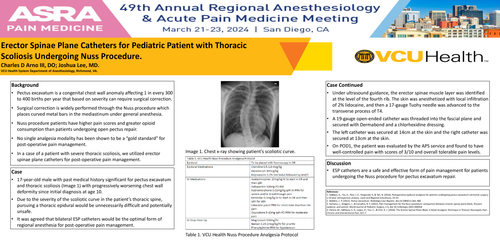
•17-year-old male with past medical history significant for pectus excavatum and thoracic scoliosis (Image 1) with progressively worsening chest wall deformity since initial diagnosis at age 10.
•Due to the severity of the scoliotic curve in the patient’s thoracic spine, pursuing a thoracic epidural would be unnecessarily difficult and potentially unsafe.
•It was agreed that bilateral ESP catheters would be the optimal form of regional anesthesia for post-operative pain management.
•Under ultrasound guidance, the erector spinae muscle layer was identified at the level of the fourth rib. The skin was anesthetized with local infiltration of 2% lidocaine, and then a 17-gauge Tuohy needle was advanced to the transverse process of T4.
•A 19-gauge open-ended catheter was threaded into the fascial plane and secured with Dermabond and a chlorhexidine dressing.
•The left catheter was secured at 14cm at the skin and the right catheter was secured at 13cm at the skin.
•On POD1, the patient was evaluated by the APS service and found to have well-controlled pain with scores of 3/10 and overall tolerable pain levels.

Discussion

•ESP catheters are a safe and effective form of pain management for patients undergoing the Nuss procedure for pectus excavatum repair.

References

1. Siddiqui, A., Tse, A., Paul, J. E., Fitzgerald, P., & Teh, B. (2016). Postoperative epidural analgesia for patients undergoing pectus excavatum corrective surgery: a 10-year retrospective analysis. Local and Regional Anesthesia, 25-33.

2. Robbins, L. P. (2011). Pectus excavatum. Radiology Case Reports. doi:10.2484/rcr.v6i1.460

3. Santana, L., Driggers, J., & Carvalho, N. F. (2022). Pain management for the Nuss procedure: comparison between erector spinae plane block, thoracic epidural, and control. World Journal of Pediatric Surgery, 1-6. doi:10.1136/wjps-2022-000418

4. Forero, M., Adhikary, S. D., Lopez, H., Tsui, C., & Chin, K. J. (2016). The Erector Spinae Plane Block: A Novel Analgesic Technique in Thoracic Neuropatic Pain. Chronic and Interventional Pain, 621-7.

49th Annual Regional Anesthesiology and Acute Pain Medicine Meeting » banner
Copyright © 2015-2026, ePostersLive® SciGen is a registered trademark of SciGen Technologies S.A. Patent pending.

This website and third-party tools we use rely on cookies for the best user experience. By selecting "I agree", you agree to cookie usage as described in our Privacy Policy.