457 posters, 2 videos, 2 audios, 8 topics, 45 sessions, 401 authors, 265 institutions
ePostersLive by SciGen Technologies S.A. All rights reserved.
49th Annual Regional Anesthesiology and Acute Pain Medicine Meeting
March 21-23, 2024 | The Hilton Bayfront San Diego | San Diego, California

5583
ERECTOR SPINAE PLANE BLOCK (ESPB) FOR POST- HIP DISARTICULATION ANALGESIA
Poster Presenter
Authors
Affiliations
Part of Topic
Medically Challenging Cases
Continuous Lumbar Erector Spinae Plane Block for Acute Post-Hip Disarticulation Pain
Norhan Ibrahim, DO1; Cooper Quiroz, MD1; Mackenzie Jacoby, MD1,; Mariam Mehrafza; Khan S; Katherine Becker; Gabrielle Santiago; Ivanov A; Nadia Hernandez, MD1
Department of Anesthesiology, Division of Regional Anesthesiology and Acute Pain Medicine, UTHealth McGovern Medical School, Memorial Hermann Hospital in the Texas Medical Center, Houston, TX.
Introduction
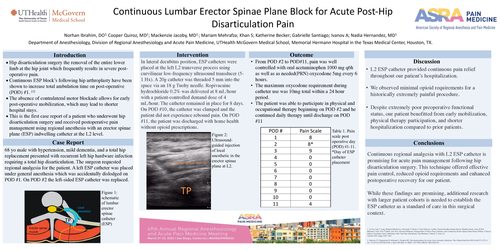
68 yo male with hypertension, mild dementia, and a total hip replacement presented with recurrent left hip hardware infection requiring a total hip disarticulation. The surgeon requested regional analgesia for the patient. A left ESP catheter was placed under general anesthesia which was accidentally dislodged on POD #1. On POD #2 the left-sided ESP catheter was replaced.
Figure 1: schematic of lumbar erector spinae catheter (ESP)
In lateral decubitus position, ESP catheters were placed at the left L2 transverse process using curvilinear low-frequency ultrasound transducer (5-1 Hx). A 20g catheter was threaded 5 mm into the space via an 18 g Tuohy needle. Ropivacaine hydrochloride 0.2% was delivered at 8 mL/hour with a patient-controlled demand dose of 4 mL/hour. The catheter remained in place for 8 days. On POD #10, the catheter was clamped and the patient did not experience rebound pain. On POD #11, the patient was discharged with home health without opioid prescriptions.
Figure 2: Ultrasound-guided injection of local anesthetic in the erector spinae plane at L2.
Table 1. Pain scale post operative day (POD) #1-11.
*Day of ESP catheter placement
Discussion
L2 ESP catheter provided continuous pain relief throughout our patient’s hospitalization.
We observed minimal opioid requirements for a historically extremely painful procedure.
Despite extremely poor preoperative functional status, our patient benefitted from early mobilization, physical therapy participation, and shorter hospitalization compared to prior patients.
Conclusion
Continuous regional analgesia with L2 ESP catheter is promising for acute pain management following hip disarticulation surgery. This technique offered effective pain control, reduced opioid requirements and enhanced postoperative recovery for our patient.
While these findings are promising, additional research with larger patient cohorts is needed to establish the ESP catheter as a standard of care in this surgical context.
1. Lei Xu, Jody C Leng, Hesham Elsharkawy, Oluwatobi O Hunter, T Kyle Harrison, Lindsey Vokach-Brodsky,Gunjan Kumar, Natasha Funck, Jonay N Hill, Nicholas J Giori, Pier F Indelli, Alex Kou, Edward R Mariano, Replacement of Fascia Iliaca Catheters with Continuous Erector Spinae Plane Blocks Within a Clinical Pathway Facilitates Early Ambulation After Total Hip Arthroplasty, Pain Medicine, Volume 21, Issue 10,
October 2020, Pages 2423–2429
2. Zalavras CG, Rigopoulos N, Ahlmann E, Patzakis MJ. Hip disarticulation for severe lower extremity infections. Clin Orthop Relat Res.2009 Jul;467(7):1721-6. doi: 10.1007/s11999-009-0769-y. Epub 2009 Mar 10. PMID: 19277805; PMCID: PMC2690754.