457 posters, 2 videos, 2 audios, 8 topics, 45 sessions, 401 authors, 265 institutions
ePostersLive by SciGen Technologies S.A. All rights reserved.
49th Annual Regional Anesthesiology and Acute Pain Medicine Meeting
March 21-23, 2024 | The Hilton Bayfront San Diego | San Diego, California

5477
FASCIAL PLANE BLOCKS FOR PAIN MANAGEMENT AFTER THORACOABDOMINAL ANEURYSM REPAIR AND AMPUTATION WITH THROMBOEMBOLIC DISEASE
Poster Presenter
Authors
Affiliations
Part of Topic
Medically Challenging Cases
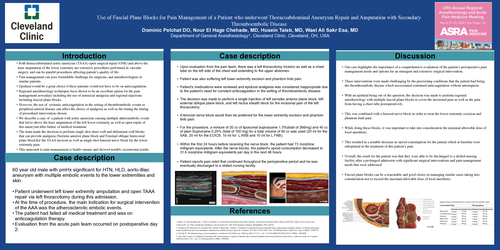
Use of Fascial Plane Blocks for Pain Management of a Patient who underwent Thoracoabdominal Aneurysm Repair and Amputation with Secondary Thromboembolic Disease
Dominic Pelchat DO, Nour El Hage Chehade, MD, Husein Taleb, MD, Wael Ali Sakr Esa, MD
• Both thoracoabdominal aortic aneurysm (TAAA) open surgical repair (OSR) and above the knee amputation of the lower extremity are extensive procedures performed in vascular surgery, and can be painful procedures affecting patient’s quality of life.
• Pain management can pose formidable challenge for surgeons, and anesthesiologists in similar patients.
• Epidural would be a great choice if these patients would not have to be on anticoagulation.
• Regional anesthesiology techniques have shown to be an excellent option for the pain management nowadays including the use of neuraxial analgesia and regional injections including fascial plane blocks.
• However, the use of systemic anticoagulation in the setting of thromboembolic events or peripheral arterial disease can affect the choice of analgesia as well as the timing the timing of procedural intervention chosen.
• We describe a case of a patient with aortic aneurysm causing multiple atheroembolic events that led to above the knee amputation of the left lower extremity as well as open repair of this aneurysm after failure of medical treatment.
• The team made the decision to perform single shot chest wall and abdominal wall blocks that can provide analgesia (Serratus anterior plane block and External oblique Intercostal plane block) for the TAAA incision as well as single shot femoral nerve block for the lower extremity pain.
• This approach to pain management is highly unique and showed notably exceptional results.
60 year old male with pmHx significant for HTN, HLD, aorto-illiac aneurysm with multiple embolic events to the lower extremities and skin.
• Patient underwent left lower extremity amputation and open TAAA repair via left thoracotomy during this admission.
• At the time of procedure, the main indication for surgical intervention of the AAA was the atherosclerotic embolic events.
• The patient had failed all medical treatment and was on anticoagulation therapy.
• Evaluation from the acute pain team occurred on postoperative day 2.
• Upon evaluation from the pain team, there was a left thoracotomy incision as well as a chest tube on the left side of the chest wall extending to the upper abdomen.
• Patient was also suffering left lower extremity excision and phantom limb pain.
• Patient’s medications were reviewed and epidural analgesia was considered inappropriate due to the patient’s need for constant anticoagulation in the setting of thromboembolic disease.
• The decision was made to perform a single injection of left serrates anterior plane block, left external oblique plane block, and left rectus sheath block for the incisional pain of the left thoracotomy.
• A femoral nerve block would then be preferred for the lower extremity excision and phantom limb pain.
• For the procedure, a mixture of 20 cc of liposomal bupivacaine 1.3%(total of 266mg) and 40 cc of plain Bupivicaine 0.25% (total of 100 mg) for a total volume of 60 cc was used (20 ml for the SAB, 20 ml for the EOICB, 10 ml for L.RSB and 10 ml for L FNB).
• Within the first 24 hours before receiving the nerve block, the patient had 73 morphine milligram equivalents. After the nerve blocks, the patient’s opioid consumption decreased to 31.6 morphine milligram equivalents per day in the next 48 hours.
• Patient reports pain relief that continued throughout the perioperative period and he was eventually discharged to a skilled nursing facility.
• Our case highlights the importance of a comprehensive evaluation of the patient’s perioperative pain management needs and options for an emergent and extensive surgical intervention.
• These interventions were made challenging by the preexisting conditions that the patient had being the thromboembolic disease which necessitated continued anticoagulation without interruption.
• With an epidural being out of the question, the decision was made to perform regional anesthesiology with multiple fascial plane blocks to cover the incisional pain as well as the pain from having a chest tube postoperatively.
• This was combined with a femoral nerve block in order to treat the lower extremity excision and phantom limb pain.
• While doing these blocks, it was important to take into consideration the maximal allowable dose of local anesthetic.
• This resulted in a notable decrease in opioid consumption for the patient which at baseline were suboptimal in the treatment of this patient’s pain.
• Overall, the result for the patient was that they were able to be discharged to a skilled nursing facility after a prolonged admission with significant surgical interventions and pain management needs that were addressed.
• Fascial plane blocks can be a reasonable and good choice in managing similar cases taking into consideration not to exceed the maximal allowable dose of local anesthetic.
1.Blanco, R., & Barrington, M. J. (2023, December 13). Pectoralis and Serratus Plane Nerve Blocks, Truncal and Cutaneous Nerve Blocks. NYSORA. https://www.nysora.com/.
2.Brown DL. In: Atlas of Regional Anesthesia, 2nd ed, Brown DL (Ed), WB Saunders Company, Philadelphia 1999. p.88-91.
3. Gurnaney HG, Maxwell LG, Kraemer FW, Goebel T, Nance ML, Ganesh A. Prospective randomized observer-blinded study comparing the analgesic efficacy of ultrasound-guided
rectus sheath block and local anaesthetic infiltration for umbilical hernia repair. Br J Anaesth. 2011 Nov;107(5):790-5. doi: 10.1093/bja/aer263. Epub 2011 Aug 19. PMID: 21856778.
4. Tetzlaff JE. The pharmacology of local anesthetics. Anesthesiol Clin North Am. 2000 Jun;18(2):217-33, v. doi: 10.1016/s0889-8537(05)70161-9. PMID: 10935008.
5. Tran TM, Ivanusic JJ, Hebbard P, Barrington MJ. Determination of spr