457 posters, 2 videos, 2 audios, 8 topics, 45 sessions, 401 authors, 265 institutions
ePostersLive by SciGen Technologies S.A. All rights reserved.
49th Annual Regional Anesthesiology and Acute Pain Medicine Meeting
March 21-23, 2024 | The Hilton Bayfront San Diego | San Diego, California

5331
INCARCERATED HERNIA REPAIR UNDER MONITORED ANESTHESIA CARE WITH BILATERAL RECTUS SHEATH BLOCKS
Poster Presenter
Authors
Affiliations
Part of Topic
Medically Challenging Cases
Incarcerated Ventral Hernia Repair under Monitored Anesthesia Care with Bilateral Rectus Sheath Blocks
Introduction
General anesthesia in patients with pleural effusions can significantly increase the risk of respiratory complications and other perioperative morbidities. Pulmonary function should be carefully evaluated and optimized preoperatively, and alternative anesthetic plans should be strongly considered.
Case Report
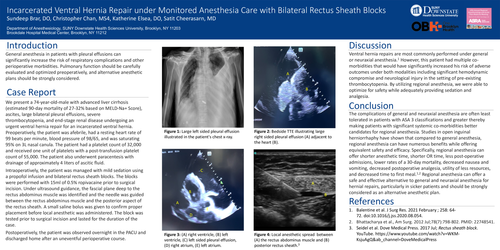
We present a 74-year-old-male with advanced liver cirrhosis (estimated 90-day mortality of 27-32% based on MELD-Na+ Score), ascites, large bilateral pleural effusions, severe thrombocytopenia, and end-stage renal disease undergoing an urgent ventral hernia repair for an incarcerated ventral hernia. Preoperatively, the patient was afebrile, had a resting heart rate of 99 beats per minute, blood pressure of 98/65, and was saturating 95% on 3L nasal canula. The patient had a platelet count of 32,000 and received one unit of platelets with a post-transfusion platelet count of 55,000. The patient also underwent paracentesis with drainage of approximately 4 liters of ascitic fluid.
Intraoperatively, the patient was managed with mild sedation using a propofol infusion and bilateral rectus sheath blocks. The blocks were performed with 15ml of 0.5% ropivacaine prior to surgical incision. Under ultrasound guidance, the fascial plane deep to the rectus abdominus muscle was identified and the needle was guided between the rectus abdominus muscle and the posterior aspect of the rectus sheath. A small saline bolus was given to confirm proper placement before local anesthetic was administered. The block was tested prior to surgical incision and lasted for the duration of the case.
Postoperatively, the patient was observed overnight in the PACU and discharged home after an uneventful perioperative course.
Discussion
Ventral hernia repairs are most commonly performed under general or neuraxial anesthesia.1 However, this patient had multiple co-morbidities that would have significantly increased his risk of adverse outcomes under both modalities including significant hemodynamic compromise and neurological injury in the setting of pre-existing thrombocytopenia. By utilizing regional anesthesia, we were able to optimize for safety while adequately providing sedation and analgesia.
Conclusion
The complications of general and neuraxial anesthesia are often least tolerated in patients with ASA 3 classifications and greater thereby making patients with significant systemic co-morbidities better candidates for regional anesthesia. Studies in open inguinal herniorrhaphy have shown that compared to general anesthesia, regional anesthesia can have numerous benefits while offering equivalent safety and efficacy. Specifically, regional anesthesia can offer shorter anesthetic time, shorter OR time, less post-operative admissions, lower rates of a 30-day mortality, decreased nausea and vomiting, decreased postoperative analgesia, utility of less resources, and decreased time to first meal.1,2 Regional anesthesia can offer a safe and effective alternative to general and neuraxial anesthesia for hernial repairs, particularly in sicker patients and should be strongly considered as an alternative anesthetic plan.
References
1. Balentine et al. J Surg Res. 2021 February ; 258: 64- 72. doi:10.1016/j.jss.2020.08.054.
2. Bhattacharya et al., Am Surg. 2012 Jul;78(7):798-802. PMID: 22748541.
3. Seidel et al. Dove Medical Press. 2017 Jul; Rectus sheath block. YouTube. https://www.youtube.com/watch?v=WKM- KsjuAgQ&ab_channel=DoveMedicalPress