457 posters, 2 videos, 2 audios, 8 topics, 45 sessions, 401 authors, 265 institutions
ePostersLive by SciGen Technologies S.A. All rights reserved.
49th Annual Regional Anesthesiology and Acute Pain Medicine Meeting
March 21-23, 2024 | The Hilton Bayfront San Diego | San Diego, California

5569
BLAME ANESTHESIA? A CASE OF FAILED EXTUBATION AFTER SHOULDER SURGERY WITH AN INTERSCALENE BLOCK AND GENERAL ANESTHESIA
Poster Presenter
Authors
Affiliations
Part of Topic
Medically Challenging Cases
Blame Anesthesia? A Case of Failed Extubation After Shoulder Surgery with an Interscalene Block and General Anesthesia
Introduction
A patient with a history of hypertension and OSA received an interscalene peripheral nerve block and general anesthesia for arthroscopic rotator cuff repair.
Pre-operative Course
Vitals: SpO2 94% on room air, BP 182/97.
PMH/ROS: denied headache, chest pain, cough, shortness of breath, recent respiratory illness, or any other illnesses. Denied smoking history. METS>4.
SpO2 97% after incentive spirometer.
Home meds: bystolic, doxazosin, nifedipine, telmisartan, furosemide, rosuvastatin.
Family history: HTN (mother and father), CAD (father had CABG)
Intraoperative Course
Pre-operative: interscalene nerve block with 15 ml’s of 0.5% bupivacaine.
Post-block vitals: BP 144/91, HR 51, SpO2 of 96% on 2 L NC.
General anesthesia induced with propofol and rocuronium, ETT placed.
Vasoactive agents required after patient in beach chair position.
Emergence:
200 mg sugammadex, patient was awake, TV>500 ml.
Developed airway obstruction, restlessness, desaturation.
Nasal airway then oral airway were placed with minimal improvement.
LMA inserted and ventilation improved.
Reintubated, TV of 800 ml’s, lungs CTA, and patient following commands.
Extubated again then quickly became short of breath with diminished breath sounds and desaturation.
IV epinephrine, albuterol, succinylcholine given.
Intubated again and transferred by ambulance to a nearby hospital with an ICU.
Postoperative Course
CXR: small left effusion, otherwise unremarkable.
TTE: normal biventricular function.
Uneventful extubation in the ICU 24 hours later.
Discharged home on supplemental oxygen.
CXR: small left effusion, otherwise unremarkable.
TTE: normal biventricular function.
Uneventful extubation in the ICU 24 hours later.
Discharged home on supplemental oxygen.
A few weeks later, presented to an ED with hemoptysis.
Chest CT revealed “4 cm left superior tracheal mass with airway narrowing.”
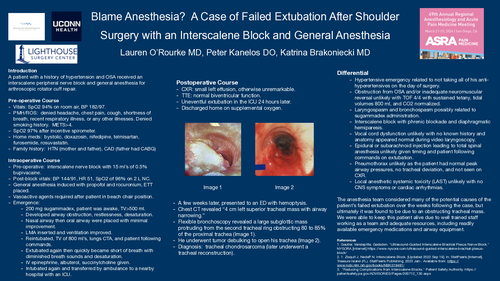
Flexible bronchoscopy revealed a large subglottic mass protruding from the second tracheal ring obstructing 80 to 85% of the proximal trachea (Image 1).
He underwent tumor debulking to open his trachea (Image 2).
Diagnosis: tracheal chondrosarcoma (later underwent a tracheal reconstruction).
Differential
Hypertensive emergency related to not taking all of his anti-hyperertensives on the day of surgery.
Obstruction from OSA and/or inadequate neuromuscular reversal unlikely with TOF 4/4 with sustained tetany, tidal volumes 800 ml, and CO2 normalized.
Laryngospasm and bronchospasm possibly related to sugammadex administration.
Interscalene block with phrenic blockade and diaphragmatic hemiparesis.
Vocal cord dysfunction unlikely with no known history and anatomy appeared normal during video laryngoscopy.
Epidural or subarachnoid injection leading to total spinal anesthesia unlikely given timing and patient following commands on extubation.
Pneumothorax unlikely as the patient had normal peak airway pressures, no tracheal deviation, and not seen on CXR.
Local anesthetic systemic toxicity (LAST) unlikely with no CNS symptoms or cardiac arrhythmias.
The anesthesia team considered many of the potential causes of the patient’s failed extubation over the weeks following the case, but ultimately it was found to be due to an obstructing tracheal mass. We were able to keep this patient alive due to well trained staff working as a team and adequate resources, including readily available emergency medications and airway equipment.
References
1. Gautier, Vandepitte, Gadsden. “Ultrasound-Guided Interscalene Brachial Plexus Nerve Block.” NYSORA [Internet] https://www.nysora.com/ultrasound-guided-interscalene-brachial-plexus-block/
2. 1. Zisquit J, Nedeff N. Interscalene Block. [Updated 2022 Sep 19]. In: StatPearls [Internet]. Treasure Island (FL): StatPearls Publishing; 2023 Jan-. Available from: https://www.ncbi.nlm.nih.gov/books/NBK519491/
3. “Reducing Complications from Interscalene Blocks.” Patient Safety Authority. https://patientsafety.pa.gov/ADVISORIES/Pages/200712_130.aspx