457 posters, 2 videos, 2 audios, 8 topics, 45 sessions, 401 authors, 265 institutions
ePostersLive by SciGen Technologies S.A. All rights reserved.
49th Annual Regional Anesthesiology and Acute Pain Medicine Meeting
March 21-23, 2024 | The Hilton Bayfront San Diego | San Diego, California

5243
NAVIGATING THE ANESTHETIC CHALLENGE: SPINAL ANESTHESIA IN REVERSIBLE CEREBRAL VASOCONSTRICTION SYNDROME DURING CESAREAN SECTION
Poster Presenter
Authors
Affiliations
Part of Topic
Medically Challenging Cases
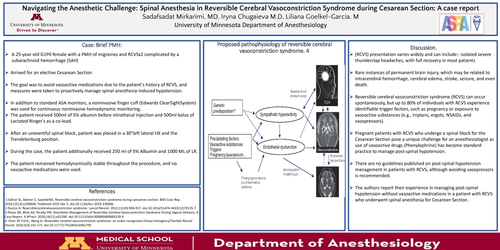
with a PMH of migraines and RCVSx2 complicated by a
subarachnoid hemorrhage (SAH)
Arrived for an elective Cesarean Section
The goal was to avoid vasoactive medications due to the patient's history of RCVS,
and measures were taken to proactively manage spinal anesthesia-induced
hypotension.
In addition to standard ASA monitors, a noninvasive finger cuff (Edwards
ClearSightSystem) was used for continuous noninvasive hemodynamic monitoring.
The patient received 500ml of 5% albumin before intrathecal injection and 500ml
bolus of Lactated Ringer's as a co-load.
After an uneventful spinal block, patient was placed in a 30°left lateral tilt and the
Trendelenburg position.
During the case, the patient additionally received 250 ml of 5% Albumin and 1000
ML of LR.
The patient remained hemodynamically stable throughout the procedure, and no
vasoactive medications were used.
Discussion.
(RCVS) presentation varies widely and can include: isolated
severe thunderclap headaches, with full recovery in most
patients.
Rare instances of permanent brain injury, which may be
related to intracerebral hemorrhage, cerebral edema, stroke,
seizure, and even death.
Reversible cerebral vasoconstriction syndrome (RCVS) can
occur spontaneously, but up to 80% of individuals with RCVS
experience identifiable trigger factors, such as pregnancy or
exposure to vasoactive substances (e.g., triptans, ergots,
NSAIDs, and vasopressors).
Pregnant patients with RCVS who undergo a spinal block for
the Cesarean Section pose a unique challenge for an
anesthesiologist as use of vasoactive drugs (Phenylephrine)
has become standard practice to manage post-spinal
hypotension.
There are no guidelines published on post-spinal hypotension
management in patients with RCVS, although avoiding
vasopressors is recommended.
The authors report their experience in managing post-spinal
hypotension without vasoactive medications in a patient with
RCVS who underwent spinal anesthesia for Cesarean Section.