457 posters, 2 videos, 2 audios, 8 topics, 45 sessions, 401 authors, 265 institutions
ePostersLive by SciGen Technologies S.A. All rights reserved.
49th Annual Regional Anesthesiology and Acute Pain Medicine Meeting
March 21-23, 2024 | The Hilton Bayfront San Diego | San Diego, California

5251
INADVERTENT FEMORAL NERVE BLOCK FOLLOWING ILIO-INGUINAL NERVE BLOCK
Poster Presenter
Authors
Affiliations
Part of Topic
Medically Challenging Cases
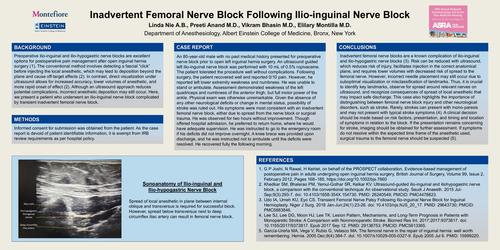
Inadvertent Femoral Nerve Block Following Ilio-inguinal Nerve Block
Linda Nie A.B., Preeti Anand M.D., Vikram Bhasin M.D., Elilary Montilla M.D.
Department of Anesthesiology, Albert Einstein College of Medicine, Bronx, New York
BACKGROUND
Preoperative ilio-inguinal and ilio-hypogastric nerve blocks are excellent options for postoperative pain management after open inguinal hernia surgery (1). The conventional method involves detecting a fascial “click” before injecting the local anesthetic, which may lead to deposition beyond the plane and cause off-target effects (2). In contrast, direct visualization under ultrasound allows for increased accuracy, lower volumes of anesthetic, and more rapid onset of effect (2). Although an ultrasound approach reduces potential complications, incorrect anesthetic deposition may still occur. Here, we present a patient who underwent an ilio-inguinal nerve block complicated by transient inadvertent femoral nerve block.
METHODS
Informed consent for submission was obtained from the patient. As the case report is devoid of patient identifiable information, it is exempt from IRB review requirements as per hospital policy.
CASE REPORT
An 80-year-old male with no past medical history presented for preoperative nerve block prior to open left inguinal hernia surgery. An ultrasound guided left ilio-inguinal nerve block was performed with 10 mL of 0.5% ropivacaine. The patient tolerated the procedure well without complications. Following surgery, the patient recovered well and reported 0/10 pain. However, he reported left lower extremity weakness and numbness. He was unable to stand or ambulate. Assessment demonstrated weakness of the left quadriceps and numbness of the anterior thigh, but full motor power of the ankle. Physical exam was otherwise unremarkable. Given the absence of any other neurological deficits or change in mental status, possibility of stroke was ruled out. His symptoms were most consistent with an inadvertent femoral nerve block, either due to spread from the nerve block or surgical trauma. He was observed for two hours without improvement. Though offered hospital admission, he preferred to return home, where he would have adequate supervision. He was instructed to go to the emergency room if his deficits did not improve overnight. A knee brace was provided upon discharge, and he was instructed not to ambulate until the deficits were resolved. He recovered fully the following morning.
CONCLUSIONS
Inadvertent femoral nerve blocks are a known complication of ilio-inguinal and ilio-hypogastric nerve blocks (3). Risk can be reduced with ultrasound, which reduces risk of injury, facilitates injection in the correct anatomical plane, and requires lower volumes with decreased risk of spread to the femoral nerve. However, incorrect needle placement may still occur due to suboptimal visualization or misclassification of landmarks. Thus, it is crucial to identify key landmarks, observe for spread around relevant nerves on ultrasound, and recognize consequences of spread of local anesthetic that may impact safe discharge. This case also highlights the importance of distinguishing between femoral nerve block injury and other neurological disorders, such as stroke. Rarely, strokes can present with mono-paresis and may not present with typical stroke symptoms (4). A clinical decision should be made based on risk factors, presentation, and timing and location of symptoms in relation to the block. If the presentation remains concerning for stroke, imaging should be obtained for further assessment. If symptoms do not resolve within the expected time frame of the anesthetic used, surgical trauma to the femoral nerve should be suspected (5).
REFERENCES
-
G P Joshi, N Rawal, H Kehlet, on behalf of the PROSPECT collaboration, Evidence-based management of postoperative pain in adults undergoing open inguinal hernia surgery, British Journal of Surgery, Volume 99, Issue 2, February 2012, Pages 168–185, https://doi.org/10.1002/bjs.7660
-
Khedkar SM, Bhalerao PM, Yemul-Golhar SR, Kelkar KV. Ultrasound-guided ilio-inguinal and iliohypogastric nerve block, a comparison with the conventional technique: An observational study. Saudi J Anaesth. 2015 Jul- Sep;9(3):293-7. doi: 10.4103/1658-354X.154730. PMID: 26240549; PMCID: PMC4478823.
-
Udo IA, Umeh KU, Eyo CS. Transient Femoral Nerve Palsy Following Ilio-inguinal Nerve Block for Inguinal Hernioplasty. Niger J Surg. 2018 Jan-Jun;24(1):23-26. doi: 10.4103/njs.NJS_20_17. PMID: 29643730; PMCID: PMC5883846.
-
Lee SJ, Lee DG, Moon HJ, Lee TK. Lesion Pattern, Mechanisms, and Long-Term Prognosis in Patients with Monoparetic Stroke: A Comparison with Nonmonoparetic Stroke. Biomed Res Int. 2017;2017:9373817. doi: 10.1155/2017/9373817. Epub 2017 Sep 12. PMID: 29138753; PMCID: PMC5613365.
-
García-Ureña MA, Vega V, Rubio G, Velasco MA. The femoral nerve in the repair of inguinal hernia: well worth remembering. Hernia. 2005 Dec;9(4):384-7. doi: 10.1007/s10029-005-0327-9. Epub 2005 Jul 6. PMID: 15999220.